

Stocks hurt by economy worries; euro rises

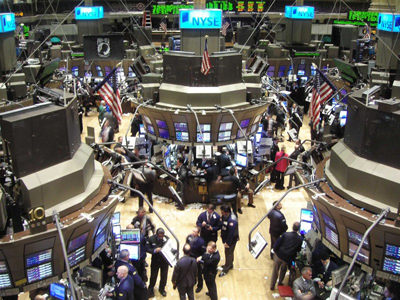 NEW YORK: Worries about the pace of the US economic recovery weighed on equities on Thursday, a day ahead of the US government's closely watched payrolls report, while the euro rallied on news of a financial lifeline for Greece.
The news of progress on a new debt plan for Greece helped Wall Street shares pare earlier losses, but with the latest US data intensifying fears that the economy could be stalling, investors were reluctant to make bets before Friday's critical labor market report on May is released.
A defensive stance ahead of the payrolls report also pulled down US Treasuries prices. Government debt was further hurt after Moody's Investors Service said the United States risked a credit ratings downgrade if its legal borrowing limit is not raised.
The euro hit a one-month high above $1.45 on news that senior euro-zone officials had agreed in principle to a new three-year adjustment plan for Greece to pay off its mountain of debt.
The US government's jobs report for May is expected to show job growth has slowed again after picking up in April.
"If you think the risks are rising, then you have got to take some money off the table just from a risk-reward perspective, and that's what we've done," said Bruce Bittles, chief investment strategist at Robert W Baird & Co in Nashville.
The Dow Jones industrial average fell 41.59 points, or 0.34 percent, to 12,248.55. The Standard & Poor's 500 Index dipped 1.61 points, or 0.12 percent, to 1,312.94. The Nasdaq Composite Index rose 4.12 points, or 0.15 percent, to close at 2,773.31.
Education stocks rallied on heavy volume after US officials relaxed rules that could have cut off tuition aid to programs run by for-profit colleges. DeVry Inc and Apollo Group Inc were the top two gainers in the S&P consumer discretionary sector. DeVry shot up 14.6 percent to $61.86, while Apollo surged 11.1 percent to $46.87.
The Labor Department said on Thursday that first-time claims for jobless benefits in the latest week fell by 6,000 to 422,000. The figure was below expectations for a decline to 415,000.
The government is expected to report on Friday that employers hired 150,000 workers in May, according to a Reuters survey, after increasing payrolls by 244,000 in April.
"Every indication we have had so far points to a slightly softer labor market in the US," said Camilla Sutton, chief currency strategist at Scotia Capital in Toronto.
Copper, a key industrial metal, closed down half a percent in New York after hitting a one-week low during the session as the weak US labor data heightened concerns about the world's biggest economy.
Weakness in the economy was further underscored by a report from the Commerce Department showing new orders received by US factories fell 1.2 percent in April after rising 3.8 percent in March.
With the US Federal Reserve set to wrap up its $600 billion bond buying program later this month, signals of more economic weakness ahead are especially worrying to investors involved in riskier assets such as equities, high-yield bonds and emerging markets.
The MSCI index of global equities fell 1.01 percent. European shares fell to a one-week closing low as the US data raised concerns about the pace of recovery.
In addition to the news on Greece, the euro was boosted after Moody's Investors Service said there is a very small but rising risk of a short-lived default by the United States if there is no increase in the statutory debt limit in coming weeks.
The euro was last up 1.2 percent at $1.44971, having risen as high as $1.4515 on trading platform EBS.
"The euro is rallying as comfort over a near-term outcome for Greece improves and the market refocuses on problems in the US economy," said Sutton. "A key psychological level is $1.45. The euro and dollar are in an ugly dog contest and the euro is winning right now."
In the US Treasuries market, the warning from Moody's accelerated losses spurred by unease ahead of the US payrolls report. The 10-year Treasury note was last down 26/32 in price and yielding near 3.04 percent, up from 2.95 percent at Wednesday's close. The 30-year bond lost 1-23/32 in price to yield 4.25 percent, up from 4.15 percent.
The weaker dollar helped push up oil prices.
US crude oil edged up 0.1 percent to settle at $100.40 per barrel. Brent crude in London finished up 1.2 percent at $115.87 per barrel.
Oil fell earlier in the day after data showing a surprise jump in US crude stockpiles and talk that OPEC production might have to go up to cool high prices, which economists said could hurt global growth.
Copyright Reuters, 2011























Comments
Comments are closed for this article.