

Stocks, oil fall as US data drives worries

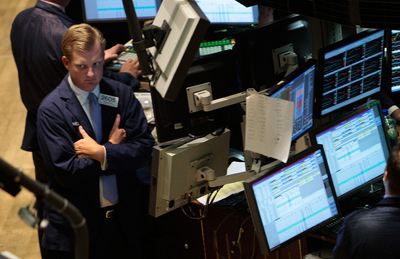 NEW YORK: World stocks and oil slumped for a second straight day on Thursday as US data kept investors on edge, with a slight drop in jobless benefits claims not enough to assuage fears about the economy's path.
The dollar fell to a one-month low against the euro as Greece agreed to new measures to cut its deficit, mitigating fears over its debt crisis and shifting investors' focus to the US economy, a day ahead of the release of the US government's closely watched report on May payrolls.
Crude oil prices slipped after an unexpected jump in crude oil inventories in the United States.
Remarks from some OPEC oil producers, including Saudi Arabia, that the group might increase the official output ceiling also weighed oil prices.
By 1543 GMT, US crude futures fell $1.43 to $98.86 a barrel, while Brent crude fell 41 cents to $114.12 a barrel, having risen more than $1 earlier.
Copper, a key industrial metal, fell to a one-week low as the US labor data heightened concerns about the world's biggest economy.
On Wall Street, the benchmark Standard & Poor's 500 index fell to a six-week low. The data showing stubbornly high jobless claims and lackluster retail sales provided little reason for investors to get back into the market.
"Every indication we have had so far points to a slightly softer labor market in the US," said Camilla Sutton, chief currency strategist at Scotia Capital in Toronto.
The Labor Department reported first-time claims for jobless benefits in the latest week fell by 6,000 to 422,000. The figure was below expectations for a decline to 415,000.
The government is expected to report on Friday that employers hired 150,000 workers in May, according to a Reuters survey, after increasing payrolls by 244,000 in April.
Appetite for risk-taking had been on the decline since late May due to lackluster data from both emerging and developed economies.
"We've been through a couple week period here where basically every piece of economic data has just been awful," said John Canally, investment strategist and economist for LP Financial in Boston.
Weakness in the economy was further underscored by a report from the Commerce Department showing new orders received by US factories fell 1.2 percent in April after rising 3.8 percent in March.
Nervous investors honed in on key market levels to manage risk a day after stocks suffered their worst one-day fall in nearly a year.
At 12:00 p.m. EDT (1600 GMT), the Dow Jones industrial average was down 70.35 points, or 0.57 percent, at 12,219.79. The Standard & Poor's 500 Index was down 5.84 points, or 0.44 percent, at 1,308.71. The Nasdaq Composite Index was down 4.15 points, or 0.15 percent, at 2,765.04.
DOLLAR, OIL DOWN; BONDS EASE
With the US Federal Reserve set to wrap up its $600 billion bond buying program later this month, signals of more economic weakness ahead are especially worrying to investors involved in riskier assets such as equities, high-yield bonds and emerging markets.
The MSCI index of global equities fell 1.01 percent.
European shares fell to a one-week closing low as the US data raised concerns about the pace of recovery in the world's biggest economy.
The FTSEurofirst 300 index of top European shares provisionally finished 1.2 percent lower at 1,117.09 points -- the lowest close since May 23. Miners were among the top decliners, with the sector index down 2.4 percent, tracking steep losses in metals prices that slipped on concerns about demand for raw materials.
The euro jumped 1 percent against the dollar to a one-month high on optimism that European officials will reach an agreement on how to help Greece repay its debt.
The euro was last up 0.8 percent at $1.4424, having risen as high as $1.4487 on trading platform EBS.
"The euro is rallying as comfort over a near-term outcome for Greece improves and the market refocuses on problems in the US economy," Scotia's Sutton said. "A key psychological level is $1.45."
But the euro's strength was not seen as steady.
"The euro's advance remains on a shaky footing, however, and we see the currency vulnerable to renewed negative headlines from the euro zone debt markets," said Vassili Serebriakov, currency strategist at Wells Fargo in New York.
If Friday's data on US nonfarm payrolls for May is sluggish, the report will likely weigh on the dollar, but the greenback could get support if the data comes in at the extremes. A a very soft or even negative outcome could offer some safe haven support, while a clearly stronger-than-expected result could encourage medium-term dollar bulls, Serebriakov said.
The unease over growth has seen investors pile into safe-haven US and German bonds, with US 10-year yields falling under 3 percent on Wednesday for the first time since last December.
Treasuries dipped slightly as investors cashed in on recent gains, pushing up the benchmark 10-year yield 3.1 basis points. But the yield stayed under 3 percent and is unlikely to rise much in the current environment.
In commodities markets, euro-priced gold fell nearly 2 percent and silver dived over 3 percent. US copper fell over 1 percent, sliding below the 200-day moving average.
Copyright Reuters, 2011























Comments
Comments are closed for this article.