


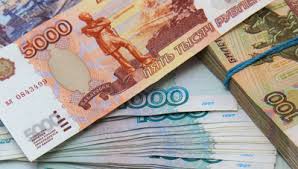
 MOSCOW: The Russian rouble rebounded on Tuesday after several sessions of falls, but analysts said the currency remains fragile and prone to breaching its trading band.
At 0800 GMT, the rouble was 0.3 percent firmer against the dollar at 34.58 and traded 0.4 percent higher at 47.27 versus the euro with weary investors betting preemptively that Turkey's central bank will act to support the lira later in the day.
The recent rout in emerging markets on worries about China's economic health and expectations of the United States to ease its monetary stimulus had pushed the rouble to all-time lows against the euro and 4.5 percent down versus the dollar.
Tuesday's firming of the rouble left it 0.3 percent higher at 40.29 against the dollar-euro basket that the central bank uses to monitor the nominal exchange rate.
This follows a heavy selloff on Monday, which forced the central bank to shift the rouble's trading band by a rare 15 kopecks after spending more than $1 billion in trying to smooth the rouble's decline.
Under its managed float, the central bank increases its interventions as the rouble approaches the boundary of the corridor.
Once an intervention allotment of $350 million is exhausted it automatically shifts the corridor by five kopecks.
"The central bank might have sold around $1.2 to 1.3 billion in the day," analysts at VTB Capital wrote in a note.
The central bank discloses its market interventions with a two-day lag. "The selling wave in rouble was stopped for some reason when Turkey's central bank announced an emergency meeting, and the market started to price in a hawkish outcome from the regulator," VTB said. "It is likely that the main idea behind the pause is that in some countries the regulators are on the cusp of further actions to fight against their currencies depreciating."
Russian equities also rose on Tuesday, with investors counting on exporters to benefit from the still weak rouble, as commodities, especially oil, remain supportive. The rouble-traded MICEX traded 0.3 percent higher at 1,484.2 points, while the dollar-denominated RTS was up 0.4 percent at 1,352.1 points.
"Russian corporates have been in an earnings recession since mid-2012," Slava Smolyaninov, an analyst at Uralsib, wrote in a note. "Our base-case remains that the Russian economy will strengthen in the second half of 2014 and earnings on the RTS index should rise 5.7 percent this year after sliding 16.7 percent last year.
"Hence, we see the current level as more attractive to start building positions in Russian stocks."




















Comments
Comments are closed for this article.