


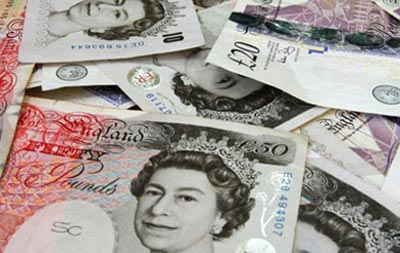
 LONDON: Sterling fell on Tuesday after British economic data continued to disappoint, keeping alive the risk of another recession with analysts expecting further weakness in the currency over the coming weeks.
Britain's Purchasing Managers' Index (PMI) for manufacturing activity rose to 48.3 from the previous 47.9, but was still below the 50 level which separates growth from contraction.
Data released by the Bank of England shortly afterwards showed mortgages approvals had fallen for a second month, hinting at signs of weakness in Britain's key housing market.
The pound down 0.2 percent against the dollar at $1.5195. Strategists said sterling could find some support around $1.5150, where buyers might emerge, but might find it difficult to rise above $1.5250 as markets remain keen to sell the currency on any rebounds.
Reported option expiries at $1.5200, could keep the currency pinned around these levels.
"The PMI number was lower than expected and in line with the general feeling of the week economic outlook for the UK," said Melinda Burgess, currency strategist at RBS.
"Also, we are not expecting any change in the BoE's stance this Thursday and expect monetary policy to remain on hold but a weak growth outlook and high inflation is not a comfortable mix for sterling," she said, adding they expect sterling to slip to $1.46 by the end of June this year.
Earlier the pound had found some support after weak US factory activity data hurt the dollar. If US non-farm payroll numbers on Friday disappoint it could drive the dollar lower against sterling, analysts said.
Against the euro, the pound had gained in recent weeks as on growing concerns about the banking crisis in Cyprus, coupled with the political situation in Italy, drove some foreign investors to discard euro zone assets in favour of sterling.
The pound also inched higher against the euro after data earlier on Tuesday showed manufacturing across Europe's major economies suffered another month of mostly deep decline in March..
CENTRAL BANK MEETINGS
The pound could benefit against the euro if conditions in the euro zone took a turn for the worse or if the European Central Bank, which meets on Thursday, hints at easier policy in the future at ECB chief Mario Draghi's press conference.
Although not the market's central scenario, some strategists spoke of an outside chance of a rate cut by the ECB, which lies in contrast to the view that the BoE, which concludes its policy meeting on the same day, will keep its bond buying target unchanged at least until May.
The euro was up 0.3 percent against sterling at 84.55 pence, some way off 84.115 pence hit on April 1, which was its lowest since Jan. 24 and could act as near-term chart support, strategists said.
"The BoE is expected to stay steady ... where we have a scope for surprise is probably the ECB as there is a chance it might cut rates," said Peter Kinsella, currency strategist at Commerzbank.
"It is not our core view, we think rates will remain on hold but the risk is there and that could put a little bit of pressure on euro/sterling in the course of the week," he said, adding that the euro could fall to 84.20 pence but was unlikely to grind lower.
Analysts said any gains in sterling would prove fleeting given the bleak economic outlook and also the risk that Britain could lose its coveted triple-A credit rating from another agency.

























Comments
Comments are closed for this article.