

Kuwait central banker says economy more vulnerable to oil prices

 KUWAIT: Kuwait's government spending boost made the economy more vulnerable to a fall in oil prices due to the OPEC member's significant dependence on crude revenue, a senior central bank official was quoted as saying by a daily newspaper on Sunday.
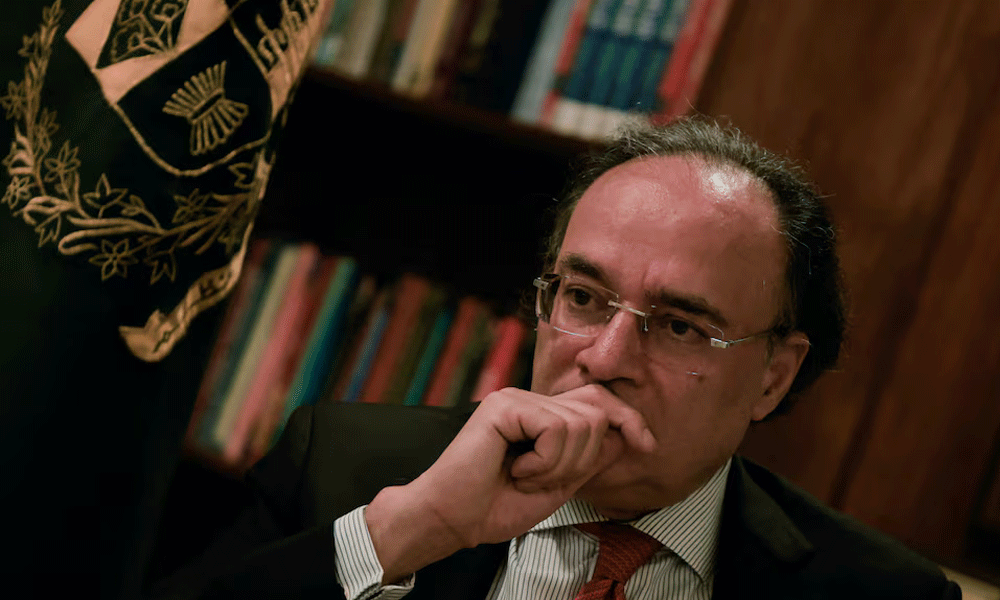
"Kuwait's economy is the most vulnerable... among GCC countries," Mohammed al-Kadi, a member of the central bank's board, told Arabic daily al-Qabas in an interview.
"They (other GCC states) are able to deal with any emergency crisis because spending in these countries on salaries, wages and subsidies did not reach the level of Kuwait's budget," he said.
Kadi also said a jump in oil prices earlier this year was considered a "catastrophe" for the Gulf Arab state because it has encouraged a steep increase in government spending rather than adding up to the country's savings.
US crude prices surged to a 2011 peak of $114 per barrel in May before dropping to around $80 per barrel earlier this month as the reduction of the top-tier US credit rating hammered markets.
In June, Kuwait's parliament approved a budget of 19.4 billion dinars ($71 billion) for the 2011/12 fiscal year, the biggest since at least 2003 and a 19 percent jump from the previous year, basing it on an oil price of $60 per barrel.
Oil revenue in Kuwait accounts for more than 90 percent of the Gulf Arab state's budget. Kuwait's fiscal year starts in April.
Sheikh Salem Abdul-Aziz al-Sabah, Kuwait's central bank governor, said last month that the state's "one-sided" dependence on oil and the government's control of all sectors are causing the main imbalances in the economy.
Kadi reiterated the governor's July remarks that filling a gap between the public and private sectors, transferring national labour to jobs in the private sector and diversification of state income were among solutions to the imbalances that Kuwait's economy was going through.
Kuwait's economy was the most hit in the Gulf by the 2008 global financial crisis as a plunge in oil prices helped send it into a contraction, which the IMF has estimated at 5.0 percent.
Kuwait is a part of the six-member Gulf Cooperation Council, a loose political bloc, along with Saudi Arabia, the United Arab Emirates, Qatar, Oman and Bahrain.
Copyright Reuters, 2011














Comments
Comments are closed for this article.