


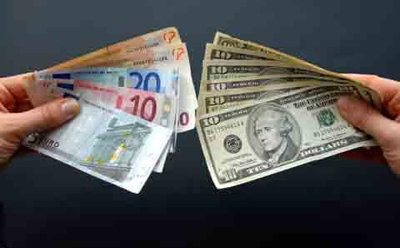
 NEW YORK: The addition of more than 200,000 US jobs last month wasn't enough to support the dollar against the euro on Friday, and the greenback may have more losses in store as markets gear up for a euro zone interest rate hike next week.
The employment report, which also showed the US jobless rate slipping to 8.8 percent in March, did push the dollar above 84 yen, its highest in more than six months, as traders expect Japanese interest rates to stay at a record low.
New York Federal Reserve President William Dudley upended a dollar rally against the euro, though, when he said he saw no reason to adjust the central bank's loose monetary policy despite the encouraging jobs data.
The European Central Bank, on the other hand, is expected to raise rates next week, the first of what some predict will be several rate increases scattered throughout the year.
"The market is finally realizing that the euro can thrive and interest rates can rise even with problems in peripheral countries," said Axel Merk, president and chief investment officer of Merk Investments in Palo Alto, California.
The euro rose 0.5 percent to $1.4240, well off a $1.4059 low. Traders said stop-loss orders around $1.4060 led to some euro buying.
The currency rose some 6 percent in the 27 days from its low of $1.3428 on Feb. 14 to $1.4249 last week, the 2011 high. Traders said a break of that could prompt a run at $1.4283, the Nov. 4 peak.
A bank stress test this week indicated Irish banks need another 24 billion euros to plug potential losses, but neither that revelation nor trouble in similarly indebted Portugal has been enough to push the euro below $1.40 in recent weeks.
Merk, who oversees $600 million in assets, said a move to $1.50 in coming months was likely, partly because the Fed is nowhere near ready to start tightening US monetary policy. Even if the Fed ends its $600 billion bond-buying program in June as planned, "that isn't an exit from easy policy, it's a pause," Merk said. "The banking system is still awash in liquidity, and they're not mopping it up. Dudley said there was no need to change anything."
YEN CARRY TRADE'S SECOND ACT
Japanese policymakers are not likely to lift interest rates any time soon, either, and that helped both the dollar and euro jump against the yen.
The greenback was up 1.2 percent at 84.15, on pace for its biggest weekly gain since December 2009. The greenback's break of its 200-day moving average for the first time since last June helped accelerate gains.
The euro hit an 11-month high at 119.78 before easing to 119.70, up 1.6 percent.
The Bank of Japan is widely expected to lag behind the Federal Reserve and the European Central Bank in raising interest rates, especially after the March 11 earthquake and tsunami.
Analysts said that will enhance yen "carry trades," which involve borrowing yen cheaply to finance more lucrative trades in higher-yielding currencies and assets.
The carry trade has "come back with a vengeance," said Boris Schlossberg, director of research at GFT Forex, and the yen could assume its former status as the funding currency of choice as rates in economies of other Group of 20 nations start to rise.




















Comments
Comments are closed for this article.