


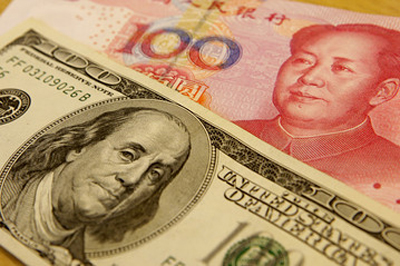
 SHANGHAI: The yuan edged lower against the dollar on Thursday after the People's Bank of China fixed its daily mid-point slightly weaker for the second day, in a sign that the central bank does not want to see non-stop rises for the Chinese currency.
The PBOC recently fixed a slew of record high mid-points, indicating the government may be using the yuan's exchange rate as part of its weaponry to fight high inflation.
But the central bank has been pulling the yuan back from time to time amid a slew of record high daily fixings, an indication that the government will continue controlling the pace of yuan rises and preventing its appreciation from inviting speculative "hot money" inflows, traders said.
"The pace is still controlled and no one wants to fight the central bank," said a dealer at a European bank in Shanghai.
"So the market took a cautious attitude today and traded in line with the fixing, awaiting fresh PBOC signals for the next round of yuan appreciation."
The yuan was trading at 6.5618 versus the dollar in early trade, down slightly from 6.5593 at Wednesday's close. The currency has now risen 4.02 percent since it was depegged in June 2010, and 0.42 percent so far this year.
Before trading began, the PBOC fixed the yuan's mid-point at 6.5625, marginally weaker than Wednesday's 6.5601. The pullback came after the central bank set two record high mid-point's on Monday and Tuesday. The PBOC has all along used a tactic of taking two steps forward, one step back for yuan appreciation, partly to frustrate speculators. It uses the fixing, from which the dollar/yuan exchange rate may rise or fall 0.5 percent each day, to express its intentions on the direction for the currency.
Despite the latest pullback, traders said they retained their forecasts for the yuan to appreciate 5 to 6 percent in 2011, a larger rise compared with 3.6 percent in 2010.
China is under US pressure for the yuan to rise to help balance bilateral trade and it also faces the threat of high inflation, aggravated by rising global commodity prices.
More importantly, Beijing appears to have learnt a lesson from the recent global financial crisis, which hit its trade and threatened to destabilise its export-reliant economy.
So the government is now adjusting its economic structure to boost domestic consumption as a pillar of growth. As such, maintaining the stability of the yuan's value to help exports is not as important as it used to be, traders said.
China's recovering economy is also giving the authorities more confidence to carry out more currency reforms, traders said.
Chinese factories have stepped up a gear this month while their price increases have slowed, indicating that the government has made some progress in taming inflation without unduly harming growth, a survey showed on Thursday.
The HSBC flash manufacturing purchasing managers' index (PMI), the earliest available indicator of China's industrial activity, rose to a two-month high of 52.5 in March, up from a final reading of 51.7 in February. A figure above 50 points to expansion on the month.
Offshore, benchmark one-year dollar/yuan non-deliverable forwards (NDFs) were bid at 6.4450 early on Thursday, up from 6.4410 at Wednesday's close. Their implied yuan appreciation in a year's time fell slightly to 1.82 percent from 1.88 percent.
Since the start of this year, NDF-implied yuan appreciation has persistently lagged market expectations of a 5 to 6 percent rise in 2011 partly because hedge funds, the main players in forwards, cut back exposure to Asian markets in favour of dollar assets as the US economy recovers, traders said.




















Comments
Comments are closed for this article.