


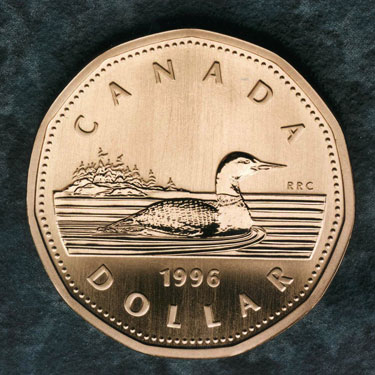
 TORONTO: The Canadian dollar dropped to a near four-week low against the US dollar on Wednesday, dragged down by weak overseas economic data and retreating oil prices.
The currency's slide was hastened by a broader rally in the US dollar, which gained against a range of currencies following the release of more upbeat economic numbers there.
"We pushed down towards the low after the data that was out this morning, and then things have steadily been reversing (back and forth) since then," said David Bradley, director of foreign exchange trading at Scotiabank.
"Given the fact that crude's down four bucks, I think the Canadian dollar's probably holding in quite well."
Crude oil prices posted their largest drop in four months during the session, hurt by fears that a recession could further hurt global demand for raw materials.
Canada's large energy industry and role as an oil and gas exporter means that the currency often follows the lead of crude prices. But the main move was courtesy of overnight data.
China's official purchasing managers' index fell sharply in September as growth in the manufacturing industry stabilized at a slower pace, raising concerns about commodity demand.
Australia's trade deficit blew out to its widest in three-and-a-half years in August as falling commodity demand ate into export earnings, while business surveys showed euro zone companies dealing with dwindling new orders and faster layoffs.
The Canadian dollar closed at C$0.9881 to the US dollar, or $1.0120, down from C$0.9843, or C$1.0160 on Tuesday.
It hit a session low of C$0.9886, or $1.0115, its weakest point since Sept. 6.
While the currency has been on the defensive of late, analysts said payroll reports due from Canada and the United States on Friday could jar it out of its recent trend.
"If the Canadian numbers surprise to the topside that would probably take some of the wind out of the sails of this move," said Matt Perrier, director of foreign exchange sales at Bank of Montreal.
Indeed, despite its recent decline, the currency is still comfortably above parity with the US dollar. And a Reuters poll published on Wednesday showed the Canadian dollar is expected to strengthen in the coming year, boosted by a hawkish Bank of Canada and the US Federal Reserve's efforts to bolster the recovery with fresh stimulus.
DATA, CENTRAL BANKS AHEAD
In addition to the jobs data, central bank decisions could impact the currency's moves ahead of the Canadian Thanksgiving long weekend.
The European Central Bank will decide on Thursday whether to hold rates or cut them to offer further support for stumbling euro zone countries.
The Bank of Japan is expected to keep monetary settings unchanged on Friday even as weakening Asian manufacturing activity clouds the outlook. The bank is seen preferring to spend some time reviewing the effects of its policy loosening last month.
Canadian government bond prices were mixed, with the two-year bond unchanged to yield 1.064 percent, while the benchmark 10-year bond rose 2 Canadian cents, yielding 1.722 percent.




















Comments
Comments are closed for this article.