


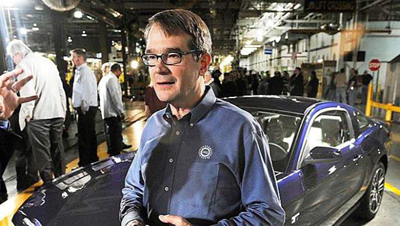
 DETROIT: Union members have to temper their expectations at the bargaining table because a steady decline in membership has eaten away at their power, the head of the United Auto Workers union said on Tuesday.
"We lost sight of how we obtained the power to win those contracts," UAW president Bob King told the union's bargaining convention in Detroit. The UAW was able to win "tremendous" contracts with employers in the auto, aerospace and agricultural and construction equipment sectors "because all three sectors were almost completely unionized," King said. But those membership rolls have been shrinking steadily as plants shut down and workers at an increasing number of plants reject unionization efforts.
The UAW alone has seen its membership fall from 1.5 million in 1979 to approximately 320,000 today. Meanwhile, the overall unionization rate in the United States fell to 11.9 percent last year as the number of workers belonging to unions declined by 612,000 to 14.7 million. In 1983, the first year for which comparable union data are available, the union membership rate was 20.1 percent, and there were 17.7 million union workers. Auto workers made major concessions in recent years as the Detroit Three struggled with a steady loss of market share to Asian competitors and the deepest economic downturn in decades forced General Motors and Chrysler into government-backed restructuring under bankruptcy protection. The UAW has little hope of reversing one major concession which set up a two-tier system of wages in which new hires are paid at half the starting wage, King warned members.
"I don't think we can get there (this year) on two tier," he said. Part of the union's overall strategy to win back the concessions is to strengthen ties with other unions in Europe and in Latin America and work towards unionizing the US plants of Asian and European carmakers. Discussions with the German and European unions have been particularly fruitful as the UAW works to put pressure on the German automakers Mercedes Benz, BMW and Volkswagen to allow US employees to unionize.
"The German unions have been great," King said. "We have greater global solidarity in auto." The UAW is also working with an independent union that is trying to replace what King described as a "corrupt union" at a Honda plant in Mexico. However, he also made it plain that the UAW will work to address the use of temporary workers who do not receive the same pay and benefits.
"When (Ford chief) Alan Mulally can make a $54 million bonus then temporary workers have the right to decent wages and benefits," said King, noting that many of temporary employees have been temps years. King said the union will continue to press for fair contracts that provide workers a share of the gains from the economic recovery which has seen Ford and General Motors post massive profits.
"We're not just fighting for our members, we're fighting for all workers," said King, adding that the UAW will continue to fight against Republican efforts to curtail collective bargaining rights of public and private sector workers in 37 states.
"Unions are under assault like they've never been before," he said, adding that members have to get ready for a major political battle.
"This is all about the 2012 presidential elections." Kit Walk, president of UAW Local 653 in Pontiac, stressed the need for unions to work together to protect all workers.
"We've got to mobilize and talk about the good unions can do for everybody," Walk told AFP. Several delegates said two-tier wages and the use of temporary workers are major issues for members. Bill Parker, president of UAW Local 1700 in Sterling Heights, said the union's Chrysler Department has made big strides in changing temporary workers in to full-time employees. But he added, "The two-tier wages divides our membership."
?




















Comments
Comments are closed for this article.