


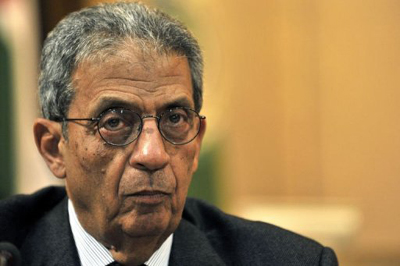
 PARIS: While the US-French-British core stayed solid, cracks started to show on Monday in the military coalition hastily assembled to take action on Libya as the Arab League and some EU countries wavered. Criticism of the operation came swiftly after French jets took to the skies on Saturday to launch the first air strikes on Libyan targets in support of UN Security Council Resolution 1973. Arab League Secretary General Amr Mussa caused concerns on Sunday when he said the air strikes went beyond the scope of the resolution to implement a no-fly zone and said he was concerned about civilians being hurt in bombing. But after a meeting with UN Secretary General Ban Ki-moon in Cairo on Monday, Mussa got back behind the military strikes.
"We are committed to UN Security Council Resolution 1973, we have no objection to this decision, particularly as it does not call for an invasion of Libyan territory," Mussa told a press conference with the UN chief. However the Arab League's concerns seemed to have left their mark when European Union foreign ministers gathered for talks in Brussels on Monday. Germany, which abstained in the Security Council vote when the resolution was passed on Thursday, said Mussa's criticism showed that Berlin had been right to fear military intervention. Foreign Minister Guido Westerwelle said: "We calculated the risks, and when we see that three days after this intervention began, the Arab League has already criticised this intervention, I think we see we had good reasons." Italy said its offer to contribute eight Tornado jets to the military operation was accompanied by concerns that the allied campaign "shouldn't be a war" on Libya.
"We want to verify all the actions undertaken are consistent with the mission objectives" under the UN Resolution, said Foreign Minister Franco Frattini.
"We do not want to go beyond the scope of the resolution." Analysts say Germany and Italy's criticism stemmed from the coalition's targeting of Libyan tanks and forces on the ground, rather than simply limiting their actions to implementing a no-fly zone. Germany's objections "are a mixture of political considerations, classic pacifism", annoyance at its fellow European power France's leading role in the operation "or poor diplomatic handling", said Dominique Moisi from the French Institute of International Relations (IFRI). Italy, formerly a close ally of Moamer Qadhafi's regime, was playing its role as "a voice of discord". While the Arab League returned to a more consensual position Monday, Mussa's approach illustrates the "schizophrenic position" of Arab states, said Jean-Pierre Maulny, of the Paris-based Institute of International and Strategic Relations. Western nations have boasted of Arab participation in the coalition, but until now only Qatar has committed fighter jets. The United Arab Emirates said Monday its involvement in Libya is limited to humanitarian assistance, despite reports that it too would send warplanes.
"Many countries are torn between the imperatives of their domestic and foreign policy: the Arab League knows Qadhafi is a problem and wants him to go, but at the same time there is a fear that Western intervention will be badly viewed by the Arab public opinion," he said. In fact, everything hinges on the definition of the "no-fly zone". Resolution 1973 permits "all necessary measures" to establish a no-fly zone to protect civilian areas and impose a ceasefire on Qadhafi's forces.
"France, Britain and the United States have never hidden the fact that technically a no-fly zone can only work if you destroy the anti-aircraft installations on the ground and the command centres," said Denis Bauchard of IFRI. But the Arab League is deliberately clouding the issue by saying that it was hoping that the "jamming" of radar would be enough to impose a no-fly zone, Bauchard said.






















Comments
Comments are closed for this article.