


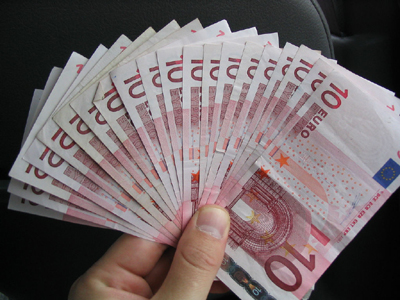
 NEW YORK: The euro fell on Monday as initial enthusiasm over a weekend victory for pro-bailout parties in Greek elections gave way to worry about the nagging debt crisis still facing the euro zone.
Market reaction was choppy as voters gave parties supporting Greece's economic bail-out a majority o n S unday, easing fears of a break-up in the euro zone and helping risk assets to rally, at least initially.
Safe-haven government debt gained in light volume as investors shrugged off Greece's election results and awaited a two-day meeting of Federal Reserve policymakers that starts on Tue sday for signs of new stimulus measures.
Investors also awaited news from Mexico, where world leaders at a G20 summit were set to put pressure on the euro zone to outline a lasting strategy to save the single currency.
Wall Street opened lower but rebounded after a senior official with Greece's conservative New Democracy party said parties that broadly back the country's international bailout will form a coalition government on Tuesday.
Greece will accelerate and widen a privatization program, while planned austerity cuts will be implemented over four years instead of two, said the source, who spoke on the condition of anonymity.
The euro was down 0.41 percent at $1.2584, while the US dollar index was up 0.37 percent at 81.933.
On Wall Street, the Dow Jones industrial average was down 18.43 points, or 0.14 percent, at 12,748.74. The Standard & Poor's 500 Index was up 2.77 points, or 0.21 percent, at 1,345.61. The Nasdaq Composite Index was up 27.23 points, or 0.95 percent, at 2,900.03.
"As we go through this period of indecisiveness ... you're going to see the markets basically whip around in a sideways pattern," said Tom Schrader, managing director of US equity trading at Stifel Nicolaus Capital Markets in Baltimore.
An initial relief rally of risk assets fizzled and prices of safe-havens such as US and German bonds, especially on the long end, rose. The swift reversal in sentiment was also fueled by data showing bad loans among Spanish banks rose to their highest since April 1994.
Steven Bell, a portfolio manager at GLC Ltd in London, a hedge fund with $1 billion under management, said the consensus view was that the Greek voting indicates a weak government.
"We have avoided 'drachmageddon,' but we're still in a very weak situation. It's almost like, 'Let's move on from Greece and let's focus on Spain,'" Bell said.
European equity markets reversed early gains to finish down or flat. Declines of 3.0 percent and 2.9 percent, respectively, for Spain's IBEX and Italy's FTSE MIB indexes, pushed regional shares lower.
Spanish 10-year bond yields were 26 basis points higher at 7.18 percent after hitting 7.30 percent earlier in the session, the highest in the euro zone's history. Yields over 7 percent are considered unsustainable.
"We're back to worries about Spain and a distrust in the euro zone in general. The question on everyone's mind is: at which level do Spanish bond yields become unbearable?," said Frederic Rozier, a fund manager at Meeschaert Wealth Management in Paris.
The euro zone's blue chip Euro STOXX 50 index ended 1.2 percent lower at 2,155.64 points, while the FTSEurofirst 300 index of top European shares closed up 0.04 percent at 993.67 points.
The price of benchmark US 10-year notes fell 2/32 to yield 1.59 percent, paring earlier gains. The 30-year US Treasury bond rose 2/32 in price to yield 2.681 percent.
German 10-year bonds yielded 1.416 percent, after earlier sliding to a low of 1.384 percent.
Spot gold rose $1.74 to $1,628.00 an ounce.
Brent crude was down $1.88 at $95.73 a barrel, sliding from a one-week high of $99.50 a barrel hit early in the session. US oil futures fell $1.10 to $82.93 a barrel.

























Comments
Comments are closed for this article.