


 FRANKFURT: The German central bank said Tuesday that growth should be around 2.5 percent this year as domestic demand picks up alongside exports, the traditional driver of Europe's largest economy.
"We expect growth of around 2.5 percent this year," outgoing Bundesbank president Axel Weber said as he presented the bank's annual results in Frankfurt.
The German government has forecast growth of 2.3 percent for this year following a record expansion of 3.6 percent in 2010 after the country's worst post-war recession saw the economy shrink 4.7 percent in 2009.
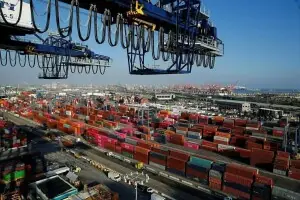
German goods such as machine tools used by Asian countries to produce consumer products have seen strong demand in a global economic rebound and luxury automobiles have also fared much better.
Data released by the national statistics office showed Tuesday that industrial orders bounced back by a provisional 2.9 percent in January, with the strongest rise seen in domestic demand.
The German recovery has "quickly balanced out" to include demand from households and businesses last year, Weber noted.
Inflation has picked up as well, meanwhile, and should reach around 2.0 percent this year, compared with 1.1 percent in 2010, before easing in 2012 unless strong wage increases come through, Weber said.
Weber steps down as head of the central bank at the end of April and has accepted a one-year post as guest professor at the University of Chicago, after which he is to take up another academic position at the University of Cologne.
He also presented the Bundesbank's annual results on Tuesday, showing a surplus of 2.2 billion euros ($3.0 billion) in 2010, down from 4.1 billion euros a year earlier.
That is bad news for the German government's budget, to which the central bank contributes any surplus it makes.
"The increase in provisions for risks is the main reason for the decline of the surplus," Weber said.
The Bundesbank and other European Central Bank members have had to increase provisions as a result of the ECB's decision to buy bonds issued by heavily-indebted eurozone governments, increasing its risk exposure.
Weber has publicly criticised those purchases on several occasions.





















Comments
Comments are closed for this article.