

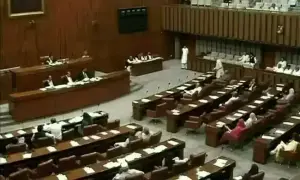
The Senate took the government to task for 'deliberately' delaying the 9th National Finance Commission (NFC) award and declared the delay as a violation of the Constitution. Article 160 (1) of the Constitution stipulates that "within six months of the commencing day and thereafter at intervals not exceeding five years, the President shall, constitute a National Finance Commission consisting of the Minister of Finance of the federal government, the Ministers of Finance of provincial governments." The President did constitute the NFC as required, however, negotiations have stalled due to what many perceive is Article 160 (3 A) of the Constitution which stipulates that "the share of the provinces in each award of NFC shall not be less than the share given to the provinces in the previous award."
The federal finance minister and other functionaries of his ministry have, in private conversations, repeatedly maintained that the 7th NFC award granting 57.5 percent of revenue from the divisible pool to provinces effective 2011-12 leaving the federal share at 42.5 percent is insufficient to meet the needs of the Centre. This claim is strengthened by the fact that in the last 9th NFC meeting held in December 2016 the finance minister proposed that the provinces allocate 3 percent from their gross divisible pool for a National Security Fund and an additional 4 percent for the development of Special Areas, including Federally Administered Tribal Areas, Azad Jammu and Kashmir and Gilgit-Baltistan. The provinces, as was to be expected, rejected the proposal and thenceforth there has been no meeting of the NFC in spite of the reported commitment by the federal government that it would schedule one in January this year. A recent press release by the Finance Ministry noted that the next budget would be formulated on the basis of the 2010 NFC award which has generated considerable angst in Sindh and Khyber Pakhtunkhwa - provinces which are not under the administrative control of the ruling PML-N. Or in other words, the onus of resolving issues relating to the next NFC would be left with the next government with elections scheduled in the first half of 2018.
This deferral, analysts argue, would provide the federal government with breathing space for the election year budget that would require considerable releases for PML-N parliamentarians for development work - a request from the latter has already been made to the Prime Minister during the meeting of the parliamentary committee of the PML-N on Tuesday. In addition, he may well be considering the possibility, though many may challenge the probability, of PML-N forming a government in provinces currently under the administrative control of opposition parties to facilitate his proposal to get the provinces to dish out 7 percent additional resources from the divisible pool for security and special development. However, he would be well advised to recall that the PPP government was unable to compel the Sindh government to allow the Federal Board of Revenue to collect sales tax on services on its behalf and it is doubtful if a provincial finance minister would toe the party line instead of the financial needs of their province.
Be that as it may, there are some sources of revenue that are not part of the divisible pool and which include gas infrastructure development cess (145 billion rupees), petroleum levy (150 billion rupees), other indirect taxes (ICT) 5 billion rupees. In addition, 16.9 billion rupees is collected under Workers Welfare Fund by the FBR and together they add up to 8.75 percent of the taxes collected by FBR and which are not shared by the provinces. In addition, the receipts from non-tax revenue have been declining given that Coalition Support Fund has not been reimbursed as quickly as requested and with this source likely to dry up soon one would hope that reliance on this source in the next budget should be realistic.
To conclude, the best way to meet the expenditure needs of the federal government is not to begrudge the provinces their due share but instead to raise revenue through implementing taxation reforms, including enhancing the tax base through heavier reliance on direct taxes (though not in the withholding tax mode as many of those taxes are on services/goods and are in the sales tax mode) that have been identified decades ago through multilateral technical assistance.
















Comments
Comments are closed for this article.