

Speaking at a press conference, the Federal Minister for Commerce Khurram Dastgir has acknowledged a decline in exports but added that growth in exports is also the responsibility of other stakeholders, including the Ministry of Finance and its associated departments, including the Federal Board of Revenue (FBR); Ministry of Water and Power, Minister of Industries and Production and Ministry of Petroleum and Natural Resources. According to him, the Sharif administration will not sign any free trade agreement (FTA) that does not safeguard the country's interests.
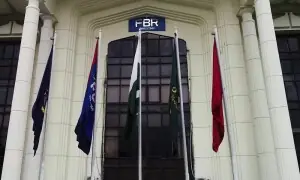
There can be no disagreement with his first claim. The Ministry of Finance is held responsible by not only exporters but also by independent economists for an overvalued rupee which makes Pakistani products uncompetitive in the international marketplace. Unfortunately, in defiance of basic economic theory, our Prime Minister and Finance Minister regard a strong rupee as indicative of strong macroeconomic credentials with the latter no doubt also finding an overvalued currency as a convenient tool to understate the rising external indebtedness of the country. Additionally the FBR, under the administrative control of the Ministry of Finance, also delays refunds with the objective of showing a deficit that is much lower than is in fact the case - a tendency that generates liquidity issues with exporters who are then compelled to borrow from the banking sector which, in turn, further raises their costs of production.
Ministry of Water and Power as well as Ministry of Petroleum contribute to rising fuel costs, apart from the taxes levied on fuel by the Ministry of Finance, through continued inefficiencies and failure to implement and sustain governance reforms. Recent data released by the National Transmission and Dispatch Company (NTDC) cited extremely disturbing examples of inefficiency in four generation companies (Guddu, Jamshoro, Muzzafargarh and Nandipur) that are producing at well below capacity, additional generation due to projects that began prior to the start of the third tenure of the Sharif administration and high transmission and distribution losses. There is also a focus by the government on investing in enhanced generation without a commensurate rise in transmission capacity - an objective that defies common sense. And then of course there is the serious issue of the continued circular debt that has resurfaced and accounts for over 450 billion rupees today.
The Commerce Minister, however, also stated that no FTA would be signed that does not safeguard country's interests. One would assume that this is the guiding principle for all decisions taken by any government anywhere in the world, including Pakistan; however what has been frequently challenged is the Sharif administration's capacity to take informed decisions, based on credible and not blatantly manipulated data - data that compromises its own capacity to formulate appropriate policies. An example is the decision to focus on generation when the transmission system is unable to support even existing generation capacity. However, Dastgir must surely be aware that nearly four years in the current tenure of his party no FTA has been signed yet and surely he must be held responsible for this failure.
To conclude, while one can support the Commerce Minister's contention that his Ministry's responsibility for the decline in exports is extremely limited, and that he has not yet signed any FTA with about a year left to the end of PML-N tenure because of his objective to safeguard Pakistan's interests then perhaps eliminating the commerce ministry maybe one way forward that would save costs and put the onus where it actually rests, as indicated by statements by exporters and independent economists.















Comments
Comments are closed for this article.