


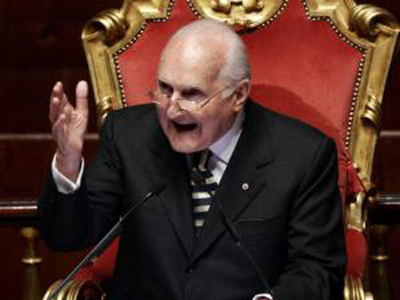
 ROME: Former Italian President Oscar Luigi Scalfaro, who was head of state during the "Bribesville" corruption affair that overturned Italy's old political order in the 1990s, has died, officials said on Sunday. He was 93.
Scalfaro, a former interior minister and speaker of the lower house of parliament, was appointed president in 1992 as the bribery and political funding scandal swept aside a party system which had run Italy since World War Two.
Politicians from the main parties paid tribute to Scalfaro's integrity and sense of responsibility in protecting the constitution which he had helped shape as a young lawyer after the war.
Mario Monti said he spoke to Scalfaro just after becoming prime minister last year. "I expressed to him personally my feelings of gratitude to him for the example he gave of public service," he said in a statement.
Although the head of state holds no executive power, his role in Italy's often turbulent political life can be extremely important as a guarantor of stability and in overseeing the timing of elections and the transition between governments.
Last year's transition between the scandal-plagued government of former Prime Minister Silvio Berlusconi and Monti's technocrat administration, overseen by the current president, Giorgio Napolitano, underlined the importance of the position.
Scalfaro's own period in office began as the Bribesville scandal was creating a corrosive mistrust in the political system that overshadowed Italy's preparations to join the embryonic single European currency.
"As President of the Republic, he faced some of the most difficult periods of our history firmly and steadfastly," Napolitano said in a statement.
Both Scalfaro's own conservative Christian Democrat party and the centre-left Socialists were shown to have been involved in a vast web of bribery and illegal funding which reached deep into public life and destroyed Italians' faith in government.
His appointment also came shortly after the murder of anti-Mafia judge Giovanni Falcone, an event which profoundly shocked Italy and heightened popular disgust with a political class that had failed to protect its own public servants.
Scalfaro, a deeply religious man who attended mass every morning, was one of the founding fathers of the Italian republic in 1946 and became well known in parliament for frequent references to his conversations with the Virgin Mary.
Despite his widely hailed sense of rectitude, he faced accusations in 1993 that he had been implicated in a murky scandal over the alleged theft of millions of dollars in funds for covert secret service operations.
He strongly denied the accusations and in a special televised address, "denounced what he called "an attempt at a slow destruction of the state", suggesting that the affair had been created to undermine confidence in Italy's institutions.
























Comments
Comments are closed for this article.