


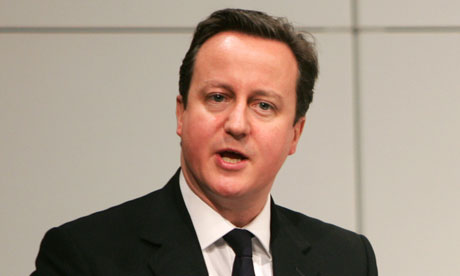
 DAVOS: Britain's Prime Minister David Cameron launched a stinging attack on his European partners Thursday, slamming the eurozone as uncompetitive and branding a planned transaction tax "madness".
The British premier took the stage on the second day of the World Economic Forum in Davos, the annual Alpine get-together for the global business elite, and revived his simmering feud with the ailing single-currency bloc.
In a speech destined to delight his own eurosceptic party back home and infuriate France's President Nicolas Sarkozy, Cameron scornfully dismissed French-led plans to introduce a tax on all financial trades.
"Even to be considering this at a time when we are struggling to get our economies growing is quite simply madness," he declared.
"Of course it's right that the financial sector should pay their share. In the UK we are doing exactly that through our bank levies and stamp duty on shares. And these are options which other countries can adopt."
"But look at the European Commission's own original analysis," he added.
"That showed a Financial Transactions Tax could reduce the GDP of the EU by 200 billion euros, cost nearly 500,000 jobs and force as much as 90 percent of some markets away from the EU."
In Brussels, the European Commission shot down Cameron's figures, with spokeswoman for taxation affairs Emer Traynor saying that the study quoted by the British PM was "being read completely out of context".
"Such figures are certainly not ones that the commission would support," she said.
"When assessing the impact of the FTT in a balanced way, we must also take into account the effect that the new revenues will also have on growth and jobs," she added, estimating the revenue at 57 billion euros a year.
"So, if the revenues are intelligently recycled into the economy, then there would be no negative impact on growth and jobs at all, even in the long term."
France, Germany and other EU nations could go ahead with a tax without Britain, but Cameron broadened his attack to encompass the whole economic management of the debt-ridden, low-growth eurozone.
He echoed a call made on the same stage Wednesday by Germany's Chancellor Angela Merkel for more measures to boost growth, but went further, calling for a root-and-branch reform of how the eurozone is managed.
"Now, I'm not one of those people who think that single currencies can never work," he insisted. "But there a number of features common to all successful currency unions."
Cameron said a shared currency must be backed with a central bank ready to act as a lender of last resort, deep economic integration between member states and a system of fiscal transfers to offset imbalances.
"Currently, it's not that the eurozone doesn't have all of these -- it's that it doesn't really have any of these," he declared.
In December, Sarkozy reportedly snapped that -- as Britain is not part of the single currency -- Cameron should shut up about its affairs.
Instead, the British leader listed the measures he would take if he were seeking to tackle the debt crisis -- quickly oversee a Greek debt writedown, recapitalise banks and set up a financial firewall to protect states.
"That's what would make the clear difference in sentiment and outlook," he said, in a clear rebuke to Merkel's cautious strategy of incremental reform and her ruling out of pooling eurozone sovereign debt.
The eurozone has caused alarm far beyond the continent and Mexican President Felipe Calderon used his speech here to urge Europe to "bring out the bazooka immediately" to prevent the problem from sinking Italy and Spain.
"It is necessary to bring out the bazooka immediately, before the gunpowder gets wet," said Calderon, who holds the rotating chair of G20 world powers.
"Don't forget that we are in the same boat. It is not just a question of a possible implosion of the euro, but a crisis across the world," warned Calderon.
Irish Prime Minister Edna Kenny, one of the eurozone members which had to rely on a bailout to tackle its debt crisis, blamed the euro's woes on internal wrangling between states and "the incompetence of some governments".
But he said individual countries should not evade their own responsiblities.
"What happened in our country is that people simply went mad with borrowing," said Kenny who came to office last year after the governing Fianna Fail party was hammered by voters over its stewardship of the economy.
Speaking alongside Kenny at a debate on rebuilding Europe, Danish Prime Minister Helle Thorning-Schmidt said the crisis was due to individual government profligacy rather than because the European project was collapsing.























Comments
Comments are closed for this article.