


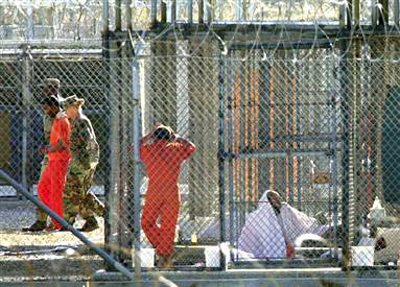
 KUWAIT CITY: Families of Arab prisoners detained without trial at Guantanamo Bay since it opened 10 years ago are despairing of seeing them again soon despite US pledges to shut the facility.
Fawzi al-Odah and Fayez al-Kandari, the only two Kuwaitis still at the centre, "may spend the rest of their lives in prison without trial," said Odah's father, Khaled, who heads a committee of families of detainees.
"Our life has changed for the worse since 10 years ago. I am suffering having to endure missing my son and at the same time trying to alleviate the sufferings of the rest of my family," Odah told AFP.
The duo are among detainees who did not receive approval for transfer from the US detention centre that was built as part of Washington's "war on terror" because they are considered too dangerous to be released, Odah said.
Ten Kuwaiti detainees have been released and sent back home and all of them got married and have children and are now leading normal lives, Odah said.
Except for one, Mohammad al-Ajmi, who is officially listed as missing while US and Iraqi authorities say he carried out a suicide attack in northern Iraq a few years ago.
US authorities initially promised Kuwait to release Odah and Kandari, aged 34 and 35 respectively, but they later retracted their pledge despite Kuwait agreeing to conditions that Odah's father described as tough.
Both of them were on charity missions and were never involved in any act of fighting, he insisted.
In total, 171 men remain in detention at Guantanamo Bay, Cuba. They come from 20 countries, but around half of them are from Yemen.
Some 89 inmates have already received the green light for transfer, which theoretically means that they are free. Most are Yemenis, but US President Barack Obama imposed in January 2010 a moratorium on the release of Yemenis.
"There remain 90 Yemeni detainees at Guantanamo," said Ahmed Armane, who takes care of the detainees file at the Yemeni human rights organisation Hood.
"We plan to organise this year a series of demonstrations demanding their release, especially after the US justice decided to release them, while they remain behind bars for reasons that we do not know," he said.
In total, 66 Yemenis were released from Guantanamo and have been repatriated to Yemen where many of them rejoined the ranks of Al-Qaeda.
As for Saudi inmates, only 10 remain in custody out of 130 who passed through the detention centre, according to Kateh al-Shemmari, a lawyer for the families of Saudi detainees.
"We demand either a fair civil trial, or their repatriation to Saudi Arabia," he said, adding that the families "have no clue about the US criteria for the release of the detainees."
"I think that the delay in the release of the last detainees is linked to the fact that some released prisoners joined Al-Qaeda in Yemen," where the jihadist network has regrouped taking advantage of the weakness of the central authority.
Some of five Saudi ex-inmates who followed a rehabilitation programme set by Riyadh for returnees have rejoined militants, a Saudi interior ministry official said in 2010.
The Saudi rehabilitation programme is run by clerics and aims at preventing ex-inmates from been drawn back into militant groups.
Copyright AFP (Agence France-Presse), 2012
























Comments
Comments are closed for this article.