


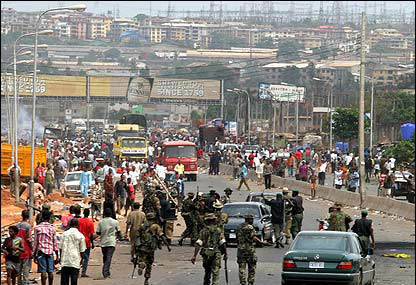
 LAGOS: Nigeria braced for a nationwide strike on Monday over soaring fuel prices amid increasingly volatile protests and with security forces already under pressure over spiralling violence blamed on rebels.
The strike comes after the government's deeply controversial move to end fuel subsidies on January 1, which caused petrol prices to more than double in Africa's largest oil producer and the continent's most populous nation.
Transport costs have followed suit, sharply increasing the price of commuting in a country where most of the 160 million population lives on less than $2 per day despite its oil wealth.
Much of the country has been united in anger against the move despite a strong push from President Goodluck Jonathan and his respected economic team to make their case for why fuel subsidies had to be abandoned.
A court ruling has sought to block Monday's strike, but it was unclear whether it would have any effect, with the country's main unions vowing to push ahead and protests being organised.
Massive security is planned, with police in the capital Abuja having announced a 15,000-strong deployment.
Protests last week became increasingly volatile, with police firing tear gas and accused of using excessive force to disperse demonstrators.
A union also accused police of shooting dead a demonstrator last week, but authorities denied the charge, saying he was killed by a mob.
The country's House of Representatives held an emergency session on Sunday and approved a measure calling on the government to reinstate fuel subsidies to allow for further consultations on the issue.
There was however no sign the government would back down.
President Jonathan sought to win support for the government's move in an address on national television on Saturday night, but unions rejected it.
Jonathan vowed to reduce salaries for political office holders in the executive branch by 25 percent as well as to improve public transport, including rail lines, among other areas.
"To save Nigeria, we must all be prepared to make sacrifices," he stressed.
Economists say removing fuel subsidies is vital for the country to improve its woefully inadequate infrastructure and ease pressure on its foreign reserves.
The government says it spent more than $8 billion (6.3 billion euros) on subsidies in 2011.
But Nigerians view the subsidies as their only benefit from the nation's oil wealth and lack any real trust in government after years of deeply rooted corruption.
The strike comes with the security forces already under heavy pressure over spiralling violence blamed on rebels group Boko Haram.
Jonathan, speaking at a church service in Abuja on Sunday, said the violence blamed on Boko Haram was worse than the country's civil war.
"The situation we have in our hands is even worse than the civil war that we fought," Jonathan said, referring to Nigeria's 1967-70 civil war that killed more than a million people.
The death toll linked to recent violence blamed on the rebels group has not reached anywhere near that level, but Jonathan cited the unpredictability and pervasiveness of the threat.
"During the civil war, we knew and we could even predict where the enemy was coming from ... But the challenge we have today is more complicated."
On December 31 Jonathan declared a state of emergency in hard hit areas, but the violence, including gun and bomb attacks, has only continued and spread to other locations.























Comments
Comments are closed for this article.