


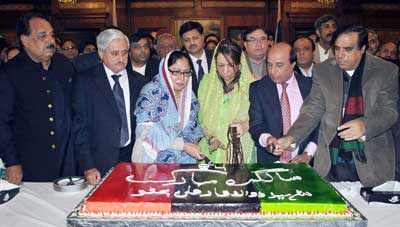
 ISLAMABAD: The 84th birth anniversary of former Prime Minister Zulfikar Ali Bhutto was celebrated across the country. Glowing tributes were paid to Zulfiqar Ali Bhutto, also known as Quaid-e-Awam, for his services to the democracy and the country.
Cake cutting ceremonies were held in provincial headquarters, Radio Pakistan, and Pakistan Peoples Party (PPP) Secretariat Islamabad. Seminars and public gatherings were also held in different cities to highlight services of the leader, who was harbinger of new values in politics of the country and always struggled for the rights of the poor and down-trodden.
Qura’an Khawani and Fateha Khawani were offered at the “Mazar” of Shaheed Zulfiqar Ali Bhutto, in Garhi Khuda Bukhsh (Larkana). The leaders and workers of PPP Sindh and other areas visited the graves of Shaheed Zulfiqar Ali Bhutto, Shaheed Mohtarama Benazir Bhutto and others to offer Fateha and place wreaths.
Bhutto laid the foundation stone of the democratic process in the county with the formation of Pakistan Peoples Party on November 30, 1967. Besides giving the nation a consensus Constitution, passed unanimously by the National Assembly on April 12, 1973, it was to the credit of Shaheed Zulfiqar Ali Bhutto to make the defence of the country invincible through initiating the nuclear programme.
Zulfiqar Ali Bhutto will also be remembered for his struggle for the rights of the poor masses and create awareness among the common man for his rights including the right to vote.
He completed his early education from Bombay’s Cathedral High School and in 1947, he then joined the University of Southern California, and later the University of California at Berkeley in June 1949. After completing his degree with honours in Political Science at Berkeley in June 1950, he got admission in Oxford University.
Bhutto married to Nusrat Isphahani on September 8, 1951, His first child was former prime minister of Pakistan Benazir Bhutto, the first women prime minister of a Muslim nation.
Zulfiqar Ali Bhutto launched Pakistan Peoples Party and in the general elections held in December 1970. The party won with vast majority in West Pakistan. Following the 1971 war and the separation of East Pakistan, Yahya Khan resigned and Bhutto took over as President on December 20, 1971.
He took many practical measures to revive the honour, dignity and respect of the common man in the country.
After the National Assembly passed the 1973 Constitution, Bhutto was sworn in as the Prime Minister on August 14, 1973. Besides starting major development projects, Zulfiqar Ali Bhutto made efforts to host the second Islamic Summit in Lahore on February 22, 1974.
General elections were held on March 7, 1977, and the PPP emerged as the victorious but at the behest of General Ziaul Haq, Pakistan National Alliance (PNA), a political alliance of the rightist forces accused the government of so-called rigging in the elections.
Negotiations with the PNA resumed and an Agreement was reached on June 8, 1977, for holding fresh elections on October 8, 1977. But on July 5, 1977, Chief of Army Staff General Ziaul Haq imposed Martial Law, dissolved the National Assembly, the Senate and provincial assemblies and held Constitution in abeyance.
Following a political crisis created by some elements for their vested interest, Zulfiqar Ali Bhutto was imprisoned by General Zia ul Haq.
On April 4, 1979, former prime minister Zulfiqar Ali Bhutto was hanged, after the Supreme Court upheld the death sentence passed by the Lahore High Court.
Besides undertaking reforms in different fields, Zulfiqar Ali Bhutto had many achievements to his credit including lifting of Martial Law on April 21, 1972, inauguration of Pakistan’s first Nuclear Power Plant at Karachi on November 28, 1972, establishment of Port Qasim Authority on June 27, 1973, starting of identity cards for citizens on July 28, 1973, agreement for repatriation of 93,000 prisoners of war from India on August 28, 1973, foundation stone laying of Pakistan Steel Mills on December 30, 1973, establishment of Allama Iqbal Open University on May 21, 1974 and holding Pakistan’s first Seerat Conference on March 3, 1976.
Despite threats from United States and other Western countries, Zulfiqar Ali Bhutto continued nuclear programme of the country. Bhutto believed in the foreign policy of bilateralism where no state would be entitled to interfere in Pakistan’s relations with other states.
The late prime minister had earned a place in the pantheon of leaders from the Third World who earned fame in the struggle against colonialism and imperialism. Bhutto’s formation of the PPP was a setback for reactionary forces in a country long dominated by rightists.
The slogan of “Roti, Kapra, Makan” (food, clothing and shelter) shifted the focus of Pakistan’s politics from theological to addressing economic issues and this focus never shifted back.
Zulfiqar Ali Bhutto did not use any influence for his release during the tenure of Ziaul Haq and refused to bow down to any pressure.
The present government of PPP with its coalition partners restored the 1973 constitution in its original form and empowered the parliament to take all decisions as envisioned by Zulfiqar Ali Bhutto.
Zulfiqar Ali Bhutto was a visionary politician of international repute, who had served as the President of Pakistan from 1971 to 1973 and then as Prime Minister from 1973 to 1977.























Comments
Comments are closed for this article.