


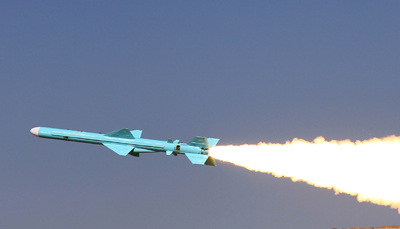
 TEHRAN: Iran Monday tested missiles near the Strait of Hormuz, underlining its threats to close the vital oil-transit waterway as the West prepares to impose more economic sanctions over Tehran's nuclear drive.
The launch of two missiles took place on the final day of war games in waters east of the strait at the entrance to the Gulf, a navy spokesman, Commodore Mahmoud Mousavi, was quoted as saying by official media.
Another missile was also to be tested Monday, he said.
France said the tests were regrettable and stressed to Tehran the Strait of Hormuz must remain open.
"We regret the very bad signal sent to the international community by the latest missile tests announced by Iran," foreign ministry spokesman Bernard Valero said in Paris, reminding Tehran of the "freedom of navigation in straits and the need to maintain a favourable climate in respect to this freedom."
The United States, which keeps its Fifth Fleet based in the Gulf, has warned it will not tolerate a closure of the strategic channel.
The longest range of the missiles tested Monday was some 200 kilometres (120 miles).
On Sunday, a medium-range surface-to-air missile was also test-fired during the exercises, according to Mousavi.
The show of military muscle was designed to show Iran's ability to close the Strait of Hormuz -- through which 20 percent of the world's oil flows -- if it chooses.
Iranian political and military officials insist they could take that drastic step if the West imposes more sanctions, on top of others that have already taken their toll on Iran's oil-dependent economy.
Western powers have imposed their sanctions to punish Iran for maintaining a nuclear programme they believe masks military objectives.
Tehran denies the allegation, saying its nuclear activities are exclusively for energy generation and for making medical isotopes.
US President Barack Obama upped the pressure at the weekend, signing into law new unilateral sanctions targeting Iran's central bank and financial sector.
The European Union is considering an embargo on Iranian oil imports. A meeting of EU foreign ministers at the end of this month will decide whether to implement that measure to punish Tehran for its controversial nuclear work.
Iran's currency was showing the impact of the sanctions, slumping more than 12 percent in street trading Monday, accelerating a slide triggered on the weekend when the United States activated new sanctions over Tehran's nuclear drive.
As an additional show of defiance, Iran on Sunday said its scientists had tested "the first nuclear rod produced from uranium ore deposits inside the country."
Iran's atomic energy organisation, which announced the news, did not specify the level of enrichment used in the trial fuel rod.
The new US sanctions seek to further squeeze Iran's crucial oil revenues, most of which are processed by the central bank.
Iranian officials have started admitting the sanctions were hurting their economy.
But their threat to close the Strait of Hormuz if the sanctions worsened has left analysts sceptical.
Some noted that Iran would devastate its own economy if it did so, likely lose the diplomatic protection it enjoys from Russia and China, and risk open war with the United States.
Monday's missile tests, however, renewed concerns over what Iran might do if it felt cornered.
Mousavi said a Qader ground-to-ship cruise missile and a shorter-range Nasr surface-to-surface missile were launched in the tests.
The Qader cruise missile "built by Iranian experts successfully hit its target and destroyed it," Mousavi was quoted as saying by the IRNA news agency.
He said it was "the first time" a Qader missile had been tested.
The Qader missile is said to have a range of 200 kilometres, which is generally considered medium-range or even short-range for a cruise missile, even though IRNA described it as "long-range."
The Nasr is based on a Chinese design, as is the other missile to be tested Monday, the Nour.
The Nasr has a range of 35 kilometres (22 miles) while the Nour missile has a range of 200 kilometres.
Copyright AFP (Agence France-Presse), 2011





















Comments
Comments are closed for this article.