


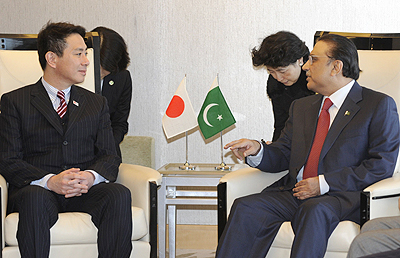
 TOKYO: Seeking cooperation of Japanese investors to explore enormous possibilities of strengthening and expanding business relations with Pakistan, President Asif Ali Zardari on Tuesday invited the Japanese Business Community to rejuvenate Pakistan's economy through their individual contribution, joint venture or consortia and help Pakistan.
Commenting on investment-friendly environment established by the present government, the President said, Pakistan is a natural route for trade and energy corridors for central Asia and west Asia and the Government has designated a 2000 acres Special Economic Zones (SEZ) exclusively for Japanese investors near the port city of Karachi. The President expressed these views in a luncheon meeting with Japan Pakistan Business Cooperation Committee (JPBCC) here at a local hotel on second day of his three-day visit to Japan.
He said that a Japan-Pakistan Special Task Force has been set up to fast-track its interaction in trade, economy and investment and to cut through the usual red tape.
"Pakistan has steadfastly pursued liberalization and de- regulation of economy, continued with liberal and friendly policies for foreign investors and the privatization process. There is no upper limit of foreign equity and no restriction on repatriation of capital, profits and dividends," the President maintained.
He said that Pakistan is strategically located in the neighbourhood of the mega markets of China, India energy rich Central Asia, West Asia and the affluent Gulf Region and it can act as a hub for exports to these regions and Pakistan's 170 million consumers, backed up by availability of abundant raw material, cheap and skilled labour.
He said that with an attractive package of tax incentives, investments in Pakistan were given comprehensive legal protection.
The President said that Pakistan is an energy deficient country and its deficiency is an opportunity for the foreign investments. Pakistan has coal deposits of 180 billion metric tones in southeast of the country and similarly the southern coast provides tremendous potential of wind energy, adding, the other key sectors offering profitable ventures are agriculture, infrastructure development and mining.
President Zardari said that Pakistan and Japan have enjoyed decades of cordial, political and economic relations but the potential existing in trade and economic sectors between the two countries is yet to be fully realized.
Pakistan with its continued economic growth has attracted more than US $ 24 billion in Foreign Direct Investments in the last ten years where an inflow of US $ 6.6 billion has been witnessed during the tenure of the present government, he said.
The major investment, the President said, were made in telecom, oil and gas, financial businesses and power sectors besides textiles, construction, chemicals, trade and transport.
The exports witnessed a growth of 10 percent in fiscal year 2010 and are projecting a very healthy outlook for the current fiscal year, the President said, adding, foreign exchange reserve are well over $ 17 billion today against $ 10.8 billion, when the government came into power.
The government has effectively controlled depreciation in the value of its currency, which is now stable and trading at an appreciated level compared to 2008-09, he added.
The Karachi Stock Exchange Index, which serves a nerve centre for the state of economy is trading well over 12000 points today as compared to 550-0 in December 2008, he said.
"Government is bringing structural reforms for fiscal discipline, transparency, improved tax governance and widening the tax net, he said, adding, it is also eliminating subsidies, containing fiscal deficit and inflation and has embarked upon a massive drive against poverty by introducing 'Benazir Income Support Programme' to support millions of poverty ridden households at their door steps and economic support to jobless youth."
He said the government is committed to support the agriculture sector, patronage of industry and trade, human resource and skill development, integrated energy programme, public-private partnership.
On the political side, the President said, the government has chosen conciliatory path with all the political force against the history of confrontation which has helped it to resolve issues of national interest and bring landmark constitutional changes with consensus.
President Zardari said that a strong economy is the key of winning the war against terrorists and their outfits, adding, people with steady employment and prospects of a better future for them and their children are less likely to turn towards violence and terrorism.
About Pakistan's economy, the President said that it has faced massive challenges and setbacks in the past few years. The devastating earthquake in 2005, worst floods of Pakistan history in July, last, the colossal impact of our role as the front-line state against terrorism, supplemented by global recession are all enough to flatten any economy of the world, he said, adding, the strength of Pakistan's economy is evident from its continuous positive growth despite these catastrophic odds.
The President said that the present government inherited a crisis ridden economy and despite its resilience the economy was under severe stress due to fiscal chaos and shortsightedness of the previous dictatorial regime. The present democratic government, he said, moved immediately to address the most immediate risks and entered into a macro-economic stabilization programme and reforms with IMF assistance, he added.
The Fiscal year 2009-2010, which was only the second of the government, witnessed a growth of 4.1 percent in GDP against 1.2 percent in the previous year, he said, adding, the major turnaround was in manufacturing sector, where a negative growth of -3.7 percent in 2008-09, turned into positive 5.2 percent in 2009-10.
The President said that the GDP in current fiscal year is expected to grow by 2.3 percent despite the fact that unprecedented floods in 2010, damaged crops on millions of hectares, livestock, agro based industry, infrastructure, disrupted manufacturing and trading activities besides displacing more than 20 million people.























Comments
Comments are closed for this article.