

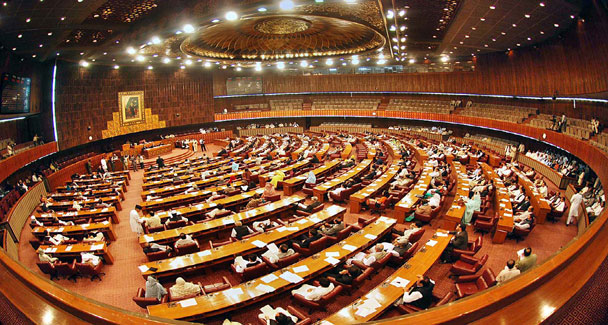
 The National Assembly on Wednesday passed the State Bank of Pakistan Amendment Bill 2011. These amendments were approved by the Senate of Pakistan in a diluted form and were found to be different from those approved by the National Assembly earlier. So, all those efforts, however noble and great aimed at putting in place an effective and meaningful mechanism to impose some restrictions on government borrowing from the Central Bank, have miserably failed. Obviously, the incumbent government - the PPP-led coalition - and the main opposition party PML(N) do not see the need to give central bank this kind of unfettered powers for obvious reasons because a fully autonomous SBP could spell trouble for them as the PPP and PML-N continue to play the game of musical chairs for control of Islamabad. The State Bank of Pakistan started as a private institution and had to be controlled by the government through the Ministry of Finance. The extent of administrative and financial autonomy of the SBP was dependent on the status of the Governor and his relationship with the Minister of Finance and the Prime Minister. After nationalisation of banking in 1972; the SBP came under the firm control of the Finance Ministry in terms of monetary policy formulation. It goes to the credit of the caretaker government of Moin Qureshi, which saw the need to give the central bank the quantum of autonomy that it actually deserved. And, President Farooq Leghari in a different caretaker set-up strengthened this autonomy further. Despite the enabling law the SBP would never have effective control over its own balance sheets as it has no control on government borrowing. The balance sheet of the SBP, like those of other central banks, happens to be unique in its importance, derived not only as the source of money creation but also as a description of its relationships with the government on the one hand and the banking and financial system on the other. Moin Qureshi established the Fiscal and Monetary Co-ordination Board wherein an agreement could be reached to put a cap on government borrowing from the SBP and from the banking system itself through control of money supply (M2). Unfortunately, however, it is only when the country is in an International Monetary Fund programme that a cap is placed on government borrowing as part of Fund's conditionalities. Due to persistent slippages there is a record of hiding the real fiscal deficit and creating quasi-fiscal deficit through public sector enterprises. The then Prime Minister, Shaukat Aziz, therefore, proposed a Fiscal Debt Limitation Act, 2005 which entailed approval from parliament to raise the level of debt-to-GDP committed to the elected body. This law, however, has not been effective in real terms as there is no consensus between our fiscal and monetary authorities on what constitutes 'Public Debt.' The SBP has been saying - clearly and loudly - that the Government is in breach of 2005 Act while the Ministry of Finance insisting 'it is not'. As a consequence, this country has not been able to see an end to this frenzy. The SBP has three major objectives: (a) the goals of its monetary policy include economic growth, low inflation, and stability of the currency; (b) immediate issues of sound management and financial health of the financial institutions; and (c) longer term considerations of financial sector development. The powers under the SBP Act lie with its Central Board of Directors. But the Board itself is quite constricted and is awash with conflict of interest. The biggest borrower, ie the government, is represented on the board by the Secretary Ministry of Finance. There are also very eminent persons on the board as directors. But most of them have to interact with the government in the course of their business dealings. A monetary policy committee comprising two nominated directors from the central board as well as two outside economists were added to the sub-committee of the board for fixing policy rates and determining other tools to be used to run monetary policy. This sub-committee did meet twice or more; but it was shelved when the Senate decided to replace it with a Monetary Policy Committee in which the Finance Secretary along with two outsiders and two representatives of the Central Board would sit. Furthermore, the proposed amendments in law were diluted when the proposal of seeking a waiver for exceeding the debt limit from the parliament, was replaced with the following: "(3) If any of the provisions of sub-sections (1) and (2) are not observed by the Federal Government, the Finance Minister shall place before the Parliament a statement giving detailed justification for the said failure." This strongly implies that the government would be required to just inform the parliament that it had exceeded the debt limit. That's it! The amendments in the SBP Act have taken away the bite the Central Bank had sought to improve its prowess. This, however, does not mean that the existing Act is short of power. The SBP itself has chosen not to exercise all its options. It can determine the policy rate and allow the market to dictate lending rates by controlling the money supply. The SBP has chosen not to do so. In other words, it is softening its tight policy stance somewhat. Instead of lending to the Government directly, it has opted to inject money through the banking system. In the process, banks are making tons of money without any real or perceived risk and the SBP is forced to inject money in the system to keep the wheels of industry moving. Why cannot the SBP lend to the government directly and simultaneously place a cap on government borrowing from the banking system? This would force banks to lend to the private sector more generously, although this sector lacks a strong appetite for private credit because of a variety of reasons, including chronic energy shortages and a fragile law and order. Printing notes adds to the money supply, whether the SBP lends to the government directly or injects in the system on a permanent basis through its open market operations. More money chasing fewer goods and services would lead to higher inflation. The SBP needs to deeply analyse the causes of rising inflation. Are they due to supply side shortages or higher demand. What is the relationship between energy shortages and lower growth, and between reduced growth and rising unemployment? Raising policy rates alone would not wish the shortages away, although the main contribution that monetary policy can make to economic management in the long run is to maintain low inflation. Is there a solution in sight? Copyright Business Recorder, 2012
























Comments
Comments are closed for this article.