

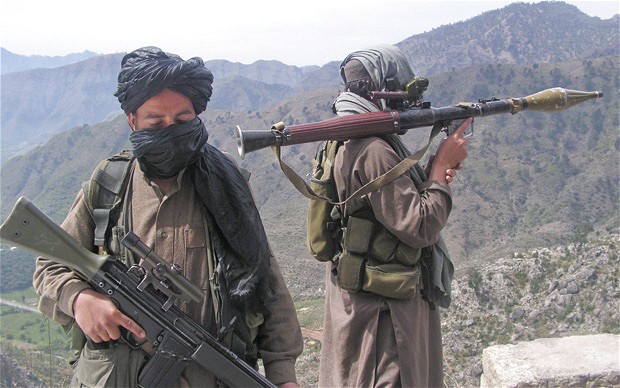
 Though it is not straight from the horse's mouth, but is now almost confirmed that the United States is in peace talks with the Afghan Taliban at the latter's newly-established office in Doha, Qatar. The nature of those talks is being described as 'preliminary trust-building measures' including a possible exchange of prisoners. Equally hush-hush is stated to be the reaction of Kabul and Islamabad, with some media reports suggesting that both would like the Saudi Arabia to be the venue of talks with the Taliban. Whatever may be factual, on the ground reality the fact remains that the 11-year-old bloody conflict has entered its endgame scenario, and this must conclude on a note of peace for Afghanistan. In the recent history no other people has suffered so much as the Afghans at the hands of outsiders, who too in the end had their pride and power rubbed in the aid dust of Afghanistan. In times to come the student of history would certainly ask what made the US-led coalition keep fighting - at enormous cost in terms of human lives and destruction - after it had achieved its objective of ousting the Taliban out of power. But is really the endgame scenario, or the eye of the storm, before it returns with even greater force. Though Pakistan has yet to take a clear stand on the Doha-based peace parleys the Karzai government is not very enthusiastic. There is no dearth of information to suggest that United States' back-channel contacts - made courtesy of Germany and Qatar, separately - with the Taliban did not sit well with the Afghan government. So much so, that President Karzai was so much upset over this development that he had recalled his ambassador from Doha. But apparently, other stakeholders prevailed upon him and the Afghan High Peace Council informed foreign missions in Kabul of its consent to let Taliban open its office in the Gulf country. As for Pakistan, a concerted effort was always afoot to keep it out of the loop. But over the last few weeks, both Kabul and Islamabad have modified their positions, at least there is nothing in the open to suggest that they are opposed to US-Taliban peace negotiations at Doha. That Pakistani authorities helped Taliban negotiators to have proper travel documentation is said to be Islamabad's 'tacit approval' of peace talks in Qatar. However, a clearer picture as to what Kabul and Islamabad think of the US-Taliban peace talks at Doha will become available later this week when Foreign Minister Hina Rabbani Khar makes her visit to the Afghan capital. Taking a sharp U-turn on his hard-hitting statements against Pakistan in the wake of Professor Burhanuddin Rabbani's assassination over the last one month or so, President Karzai has made a number of conciliatory moves - as Turkey stepped into ease tension between Afghanistan and Pakistan. In fact, it's their common perception of the post-foreign forces withdrawal Afghanistan that is largely instrumental in bringing them closer. To them the fundamental issue is not who would control Kabul after 2014 when foreign forces would have pulled out, but as to whether the pullout would be real or cosmetic. It is the West's not-any-more secret plan to keep effective military presence in Afghanistan after the withdrawal deadline that is of concern to Kabul, Islamabad and a number of other regional countries. Rightly then, both Kabul and Islamabad feel sidelined in this peace process. By agreeing to hand over the Taliban prisoners to Qatari custody instead of sending them to Kabul the Americans seem to be interested more in cutting the peace deal with Taliban than President Karzai. As for Pakistan, it is out of the loop ever since the Abbottabad raid last year. Though no one would like to be looked as detractor of a move for peace in Afghanistan, but matters more is that the peace has to be durable and lasting instead of a deal essentially to smooth the retreat of foreign forces from Afghanistan. Let Doha be the venue for prisoner exchange and initial confidence-building contacts. But for an agreement which should help obtain genuine national reconciliation in Afghanistan the Saudi mediation is the best option. Copyright Business Recorder, 2012
























Comments
Comments are closed for this article.