

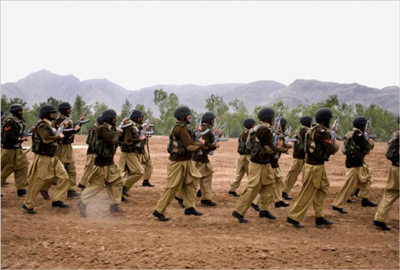
 In a surprise but much welcome decision on Wednesday the Federal government decided to put the Frontier Corps (FC), a paramilitary force, under the administrative control of the provincial government as part of its Aghaz-i-Haqooq-i-Balochistan package. The package so far had focused on economic development, and ignored the more inflammable issues like the presence of FC checkposts in certain sensitive parts of the province, and 'enforced disappearances'. The level of resentment the FC activities generate is plain from recent reports that the provincial government had refused to allow the force to operate in the urban areas. Resultantly, there is no co-ordination between the police working under the provincial government, and the FC which technically is answerable to the federal Interior Ministry. Manned by officers drawn from the Army and other personnel from the Rangers, and headed by a seconded army officer of a rank not below major general, the FC is supposed to answer to the Interior Ministry, but in practice it is independent of civilian control. This allows the Army and the Federal government to insist, as ISPR spokesman Major General Athar Abbas insisted on Wednesday, that "since January 2008, the military has conducted no operation in Balochistan." Baloch people though do not agree and have been demanding the removal of FC checkposts from civilian areas. They also accuse it of involvement in 'enforced disappearances'. Press reports say that in his meetings with Prime Minister Yousuf Raza Gilani, Balochistan Chief Minister Aslam Raisani had been repeatedly raising the issue of the FC, which he complained was working at cross purposes with his government, and hence needed to be placed under provincial control. Raisani has also been saying for sometime that if he is given the authority to talk to the 'angry Baloch youth' he could bring them back into the political mainstream. The fact of the matter is that at the root of the Baloch insurgency is a backlog of political problems which can be best addressed through political means only. Use of force only aggravates people's sense of being wronged. The present decision comes at an opportune time, when the Balochistan High Court is pursuing the Nawab Akbar Bugti murder case, which has become a symbol of Baloch resistance to injustices. These developments should improve the environment for the provincial government to talk to different 'angry' elements within the nationalist parties and insurgent groups. Needless to say, it will not be helpful if the change in the FC's administrative authority is for appearances' sake only. The provincial leadership must have effective control over it. Equally important, the issue of 'enforced disappearances' ought to be resolved without any further let or hindrance. Denial will not resolve anything. The CM must have a free hand in dealing with anyone he deems appropriate, and his commitments fully honoured. Hopefully, the present decision is part of a bigger strategy to resolve the Balochistan issue through broad-based and meaningful efforts. Copyright Business Recorder, 2011






















Comments
Comments are closed for this article.