

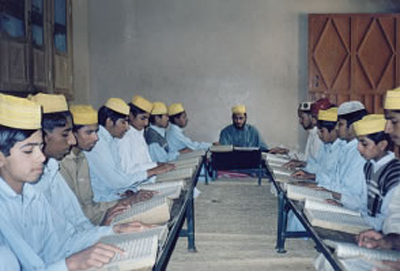
 The government, according to media reports, has finally awoken to the simmering issue of Madrassa Reforms and has asked the seminaries to update their curriculum at the earliest. The reforms plan for the Madaris has been under the spotlight since after the 18th Amendment, the religious education has been devolved to provinces. The Ittehad-i-Tanzeemat-i-Madaris Pakistan (ITMP) (an alliance of seminaries organisations), has also agreed to introduce compulsory contemporary subjects at matric and intermediate levels as well as accept the formulation of a regulatory body which would overlook the five wafaqs, which will be considered as full board. The issue of Madrassa reforms is an old one. The government of Pakistan launched a comprehensive Madrassa Reforms Programme (MRP) in 2002 but it failed to bring the desired results. An ordinance passed by the then president, General Pervez Musharraf, made it incumbent on all the madaris to register with the government and include modernised syllabus but the religious bodies, despite the passage of almost 10 years, have successfully managed to stave it off. As per current statistics, there are approximately 20,000 madaris in the country, belonging to different wafaqs, and till August this year, there were around 11,000 registered seminaries. Various initiatives have been taken by different stakeholders to modernise the curriculum that is taught in the madaris but things haven't borne the fruit. The main concern is that the traditional, extremist elements use these madaris to spew venom against western societies and encourage the element of terrorism and extremism. Madaris, particularly those in the Fata regions and some in Punjab, are alleged to have provided combat training as well as theological brainwashing in order to prepare fighters. Madaris were given the elevated status of degree awarding institutes back in the early 1980s during the Zia era. Due to low fee structure, the decision ensured a high number of students joining them. However, owing to the outdated curriculum, which could not meet the knowledge-based industrial needs, the graduates were often unskilled and unable to compete with their urban counterparts. Despite this evident flaw, the number of madaris jumped manifold. From 2,800 madaris in 1988, the number increased to over 10,000 till 2002, showing the far-reaching effect of madaris. According to a WikiLeaks cable from 2008, despite an allocation of 100 million dollars by the government of Pakistan, the education ministry could only utilise 4 million dollars. Another report back in 2009 suggested that the USAID funded 71 million dollars to revamp and redesign the curriculum on modern lines but the project was slated to lapse in 2010 with the ministry only able to utilise 5 million dollars. It must be understood that the madaris and their network provide a sound basis for a lot of relief and humanitarian work. They have access to remote areas which government authorities do not have. Madaris and their patron also hold more power in the local community, which makes them more influential. They promise to provide food and shelter to pupils free of cost. Along with low fees and provision of free accommodation plus food, these madaris are able to create major influence within the community. Thus it is even more imperative that government determine how they want to bring about the change. Madaris in Pakistan are divided into various sects and they respectively wield influence in their dominant areas. Some of them have colluded with nefarious elements in the past to promote militancy through what they call jihadist literature. The need of the hour is to eliminate these through a severe crackdown. This should be followed by the implementation of a rigorously studied and designed curriculum, keeping the native sensibilities into consideration. Compulsory contemporary subjects should be given top priority and align them with traditional religious subjects which are already taught. Special monitoring cells should be formed within the top regulatory body for madaris which should be ensured consistency and adherence to the curriculum while identifying anybody found guilty of preaching extremist, hate literature. The government needs to take concrete steps at the earliest to register and redesign the curricula for religious seminaries. They have often been touted as the "incubators of violent extremism" and institutions that breed future terrorists, according to Western perception. This can only be changed if this potent education system is taken under provincial governments' wings in consultation with a federal regulatory body to ensure uniformity in the quality of religious education along with contemporary education. Copyright Business Recorder, 2011





















Comments
Comments are closed for this article.