

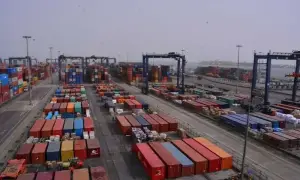
Brazil's dominance on world commodities markets over the centuries was built on the flow of ships through Santos, which is expected to triple movement of cargo over the next 15 years as it has over the past 20, the port authority said. Latin America's largest port is poised to move a record 100 million tonnes of goods this year, up from 96 million in 2010.
The port accounts for 26 percent of Brazilian trade. The country's bond with the port is not likely to weaken in the future, despite the rise of smaller ports across vast country the size of the continental United States. The world's biggest deep-water oil discoveries just off the coast of Santos will help guarantee the port's and surrounding area's importance as a staging ground for the off-shore production of so-called subsalt crude and natural gas. Serra said the port was roughly the same size as it was 20 years ago when it moved just over 30 million tonnes of cargo.
"We tripled movement entirely by logistic intelligence and this is key to future growth. But we will have to expand physically to triple again. We will build new terminals." Brazil's history as a world leading exporter of soft commodities such as sugar, coffee and orange juice has been shaped by Santos, the main export corridor for these breakfast commodities as they are sometimes called.
One has only to look at the engineering feats of the modern highways, tunnels and railways leading down through the Serra do Mar mountain range to the coast. Since the emergence of tropical soybeans, which allowed farmers to plant closer to the Equator and sow Brazil's vast center-west savanna with the oilseed, Santos has also become an important port for soy and corn shipments.
It now moves almost as much soy as Brazil's main grain port of Paranagua to the south. But the export of soybeans will increasingly spread with the new production areas, especially in the Amazon ports in the north, which will be a shorter haul from the main growing areas in the center-west, Serra said.


















Comments
Comments are closed for this article.