


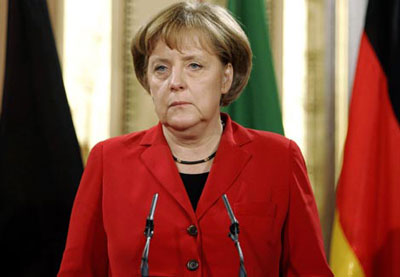
 BERLIN: Chancellor Angela Merkel's conservatives licked their wounds on Monday after a crushing defeat in the first of this year's seven state elections.
Sunday's vote in Hamburg, Germany's second city saw Merkel's centre-right Christian Democrats (CDU) crash to just 21.9 percent of the vote, less than half their score from the last election in 2008, ending a decade in power there.
The centre-left Social Democrats (SPD) triumphed with 48.3 percent of the vote in the northern city state, returning them to office in a city that until the CDU's 2001 victory had been a left-wing bastion.
"This is a painful day for the CDU in Hamburg," outgoing CDU mayor Christoph Ahlhaus said, calling the result a "bitter defeat".
Once the SPD has formally formed a government, the result gives the opposition firm control of the federal upper house in Berlin, the Bundesrat, constricting Merkel's ability to push through legislation.
"This was a historic result, not just for us, but also for others," a beaming SPD chief Sigmar Gabriel said on Sunday night.
"Merkel and her coalition in Berlin must now face up to not winning back a majority in the Bundesrat in the foreseeable future," the Koelner Stadt-Anzeiger daily said.
Merkel, meanwhile, was conspicuous by her absence in the immediate aftermath of the election result, leaving a glum CDU general secretary Hermann Groehe to admit it had been a bad night.
"The CDU has suffered a heavy defeat. This is a big blow for the CDU in Hamburg," he said. Merkel was due to give a statement at 1200 GMT.
Germany's biggest circulation daily Bild called the result an "election hammering", a "massive victory for the SPD".
Now the opposition have their eyes on a much bigger prize: ending almost six decades of unbroken rule by the CDU in the southern state of Baden-Wuerttemberg on March 27.
But support for the SPD nationally is nowhere near what it is in Hamburg, with local issues having played a big role.
"Hamburg is not Germany," Klaus-Peter Schoeppner from polling institute Emnid told AFP. "This was a one-off result."
A poll last week put the CDU as the most popular party country-wide, with 36 percent support against 22 percent for the SPD.
But the SPD and the Greens still hope to make it an uncomfortable year for Merkel, 56, and that the Hamburg result will boost their support in other states.
Merkel ditched the SPD at the last general election in September 2009 in favour of a coalition with the pro-business Free Democrats (FDP).
Billed as the "dream coalition", it has disappointed many voters, with internal squabbles over several major issues and Merkel under fire for her handling of the euro crisis.
More recently, the coalition has been hit by a scandal over Defence Minister Karl-Theodor zu Guttenberg, who is under pressure after accusations he plagiarised his doctoral thesis.
Last May the coalition lost power in an election in North Rhine-Westphalia, Germany's most populous state.
Voters in SPD-controlled Rhineland-Palatinate also go to the polls on March 27, while other elections include Bremen in May and the capital Berlin in September.
In Hamburg, the FDP, this has seen its poll ratings slump nationally. managed to increase its share of the vote to 6.6 percent from 4.8 percent last time.
The Greens meanwhile, who have high hopes for the Baden-Wuerttemberg election and for Berlin in September, saw its score improve to 11.2 percent from 9.6 percent.
























Comments
Comments are closed for this article.