


 DUBAI: A tale of forbidden love in the Gaza Strip won the top prize at the eighth Dubai Film Festival on Wednesday, where a new generation of Arab women directors stole the spotlight.
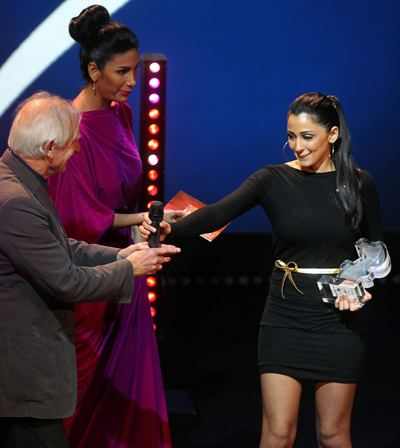
"Habibi" (My Love in Arabic), directed by Susan Youssef, won Best Arab feature film, and the film's star, Maisa Abdel Hadi, won best actress.
The film, which also won the best editor award, tells the story of two Palestinian lovers, Qais and Leila, growing increasingly religious under the control of the group Hamas.
The couple meet at university in the West Bank, but both are expelled by Israeli authorities to Gaza.
Leila's brother is a Hamas member, and her relationship with Qais is forbidden. In one scene, the two are arrested on a beach for being together out of wedlock, forbidden under the sharia Law.
They both try to escape the Israeli-blockaded territory using false visas, but the plan is thwarted by Israeli authorities, and the film ends with Leila being forced into an arranged marriage with a man picked by her father.
Youssef cried upon receiving the award, and in her acceptance speech said: "I hope we can show the film in Gaza."
The young director said she began shooting the film in Gaza, but was forced to relocate after Israeli authorities blocked her from travelling to the territory.
She told AFP that she was prompted to make the film after she "fell in love with a theatre director in Gaza."
Youssef, who is originally Lebanese but grew up in the United States, said that "Habibi", her first film, cost less to make than "a luxury car in Dubai."
Jordanian filmmaker Deema Amr also tackled the social pressures facing women in Arab countries in her film "A 7 Hour Difference".
The film tells the story of Dalia, a college student in the US who returns home to Jordan to attend her sister's wedding but the celebration turns sour when her American boyfriend turns up in Amman unannounced.
Dalia confesses the affair to her father, who then tells her to end the relationship:
"I asked you to come back to Jordan with a degree, not with a boyfriend," he says.
Lebanese director Danielle Arbid, presented her third film "Beirut Hotel," which narrates a love affair between a Lebanese singer and a Frenchman set against the backdrop of the assassination of prime minister Rafiq Hariri.
Arbid's film showed relatively steamy and intimate scenes, unusual for Arab cinema, and was barred from screening in Lebanon because of its reference to the Hariri assassination.
Female directors also starred in the documentary category, including, Sudanese filmmaker Tagrid Elsanhouri and French-Algerian counterpart Yasmina Adi.
Elsanhouri's "Our Beloved Sudan" tells parallel stories of the struggles faced by the director's mother, forced to marry a man with three wives, and the events that led South Sudan gaining independence from Khartoum.
Adi's "Here We Drown The Algerians" follows the brutal suppression of the 1961 demonstrations by Algerian immigrants in France, demanding their country's independence from French rule.
"London Through The Eyes Of A Veiled Woman," a film about the struggles of a young Emirati woman studying in the West, also earned critical acclaim, in a festival where more than 170 films were screened since December 7.




















Comments
Comments are closed for this article.