

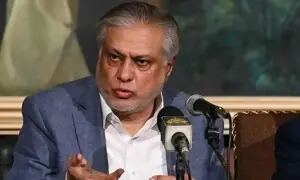
Chairman, Revenue Advisory Council (RAC) and former federal finance minister, Dr Hafeez A. Pasha has said that the next federal budget will concentrate on 'equity, revival and self-reliance ' and there will be no new tax or upward revision of the existing tax rates.
He was addressing a pre-budget seminar, which was organised by the Institute of Charted Accountants of Pakistan (ICAP) here on Saturday. Former FBR Chairman Abdullah Yusuf was also present on the occasion.
Hafeez disclosed that the wealth tax will be substituted with asset-based minimum alternative tax. He was of the view that the economy has taken a hit, especially after the floods, and hence the overall growth rate will be 2.5 percent while the industrial growth will be one per cent this year. "Over the last four years, the country has witnessed low growth rate (on average 4 per cent) and high inflation. In this environment, a budget is being prepared that maintains the country's dignity and pursue policy of self reliance," he added.
According to him, was learnt from the government's efforts to impose Reformed General Sales Tax (RGST) that the people have problems with the existing tax system for two reasons. One, the tax system in the country is fundamentally unfair and inequitable, which only favours the elite class. And secondly, they have a strong reservations about the utilisation of taxes and revenue by the government.
A perception of mismanagement, corruption and bad governance has become a hallmark in the people's mind. Hence, combination of these factors brewing a revolt against tax in the country, as tax compliance is dropping rapidly. He was of the view that RGST could not be enforced in a harsh manner.
Dr Hafeez called for addressing these issues in the forthcoming federal budget and thus it will focus on equity, revival and self-reliance. "So there will be no enhancement in the existing rate of taxes while efforts will be made for improving tax enforcement and compliance. The culture of tax evasion and under payment had deeply penetrated in the society. Numbers of non-filers and underpayments were alarmingly high. However, through Resource Mobilisation Strategy and data cross-matching with third party sources the FBR had identified some 700,000 non-filers and the first tax payment of Rs 700,000 had been recovered from one non-filer," he added.
He also spoke about shift in tax collection from the federation to provinces after the passage of 18th Amendment. He said now the provinces have the autonomy to collect taxes in the area of agriculture, sale tax on services and property, and they can no longer raise slogan of tax-free budget. He said the forthcoming budget would focus on the provincial taxation and capacity building of the provincial tax machinery related to enforcement and compliance. "Fiscal responsibility has been shifted to the provinces and thus they have to contribute in increasing the tax to GDP ratio," he added.
While quoting a research, he said the provinces has the potential of accumulating agriculture income tax between Rs 42 billion and Rs 45 billion, which translate into 0.25 percent of the GDP. "Also, the provinces have the potential to collect Rs 80 billion to Rs 85 billion from sale tax on services, which is around 0.5 percent of the GDP," he added.
He pointed out that earlier the provinces had been maintaining positive lists, but now it had been principally decided to maintain a negative list for tax purposes, thus a few social sectors (like health and education) would be exempted, while the rest of the sectors would be brought under tax net.
On wealth tax, he said the past experience of imposing Wealth Tax was unsuccessful, but it was being introduced for overall compliance. He said it was under serious consideration that the focus of the wealth tax would be shifted to assets. "However, if two or more provinces successfully enhance presumptive rates and property tax, alternative minimum tax might be withdrawn. If the provinces fail and the Constitution allows, the government will have to shift to alternative minimum tax," he added.
He also hinted at introducing a special package for capital market development, adding that some tax measures for banking industry are also under consideration. He disclosed that agriculture produce agent would also be brought under tax net. However, so there was no question of raising tax rate for salaried class to avoid putting extra pressure on the salaried individual, he added. He welcomed ICAP suggestion of imposing Withholding Tax (WHT) on industrial usage of gas, but added that the government has taken a principle stand of not imposing new taxes. However, he hinted at increase in gas prices for better utilisation of this scarce resource.
While rejecting the idea of taxing remittance, the government has no intention of taking this step, since it will discourage remittance to the country. Former FBR Chairman Abdullah Yusuf admitted that despite the efforts made in the past, the desire level of tax-to-GDP ratio was not achieved. He said the country sustainability depends on the mobilisation of resources and rationalisation of expenses. "Under the prevailing circumstances, it is not manageable. The current fiscal deficit is not sustainable, which has to be lowered. Thus we have to generate local resources and show less reliance on foreign assistance, which has a price tag," he added. ICAP President Saqib Masood also spoke on the occasion.




















Comments
Comments are closed for this article.