

On April 27 the fifth general assembly of the World Forum of Fisher People (WFFP) was hosted in Karachi by the Pakistan Fisherfolk Forum (PFF). There were representatives from India, Sri Lanka, Canada, South Africa, Spain, Senegal, Mali, Guinea, France, Thailand and the Philippines. The world forum has four million member in 32 countries yet astonishingly their problems are identical.
The moot highlighted two important traits of fisherfolk of the world: that they are the most neglected and exploited community; that they are a people who never give up the struggle no matter how hopeless and fruitless it may be. They deserve our sympathy for the former and our respect and admiration for the latter. Their resilience is a trait developed from working in the most inhospitable of Earth's regions, water. Lakes, rivers and, most of all, the seas and oceans are not kindly hosts. Even the calmest can be treacherous, yet the fisherfolk live and love the daily contest they wage with nature.
But now it is not just nature they must battle with the survival; they have to fight against technology, the great mechanical fishing systems that plunder the marine wealth, fishing the seas to the point of destroying the ecology and many species. They must battle against the trend all over the world to develop resorts by the rivers and seas and seaside housing, pushing out fisherfolk from coastal fishing grounds and from villages too. This is a world-wide phenomenon, one had imagined it was peculiar only in Karachi.
I might add a third important universal characteristic: fisherfolk are the most tolerant and apolitical people. This might not seem true considering the politicisation of the people of Lyari who are mostly fisherfolk in origin although they have settled down to other type of work such as donkeycart driving and industrial labour.
But the gangsterism and criminal activities of Lyari do not define fisherfolk. They are bad news and bad news tends to overshadow what is good. To know the real tolerance and a political character of fisherfolk one should look at who are the fisherfolk of Karachi. They are not all Makranis. There are Bengalis, Sindhis, Malabaris, Koknis from the western coast of the sub-continent, Punjabis and even a few Pathans who have adopted fishing as a new and challenging occupation.
When you see them at a moot you cannot tell one from the other, they are so well integrated. Kutchi dialect seems to be the lingua franca, although the most commonly heard is a dialect of Sindhi and, of course, Makrani which, I think, is a form of Balochi Persian. Urdu is understood and spoken by all. I have been to remote fishing villages in Badin district and found the men and women could communicate in Urdu with us. So there is no universal language and there is no common ethnicity. This is remarkable, and it is the reason why there is no strong interest in participating in politics or adopting political attitude.
At the world forum Sindh Fisheries Minister Zahid Hussain Burghari attempted to portray fisherfolk to be supporters of PPP by claiming that when the PPP was in the opposition it took part in campaigns of the PFF. No doubt it did, and it also deserves credit for passing the bill to abolish contract system. But, and it is a big but, they have really done nothing useful to improve the lot of fisherfolk or to resolve problems of water, housing and even the building of small jetties in fishing villages.
Burghari is an enthusiastic and sincere person but the real credit for any achievement goes to the PFF. What has the PPP done to fulfill promises made to fisherfolk? Mubarak Village was to be made into a model fishing village. This was announced by Sindh Chief Minister Syed Qaim Ali Shah in October 2009. The village is still waiting for the promises which include supply of potable water, electricity, health and education facilities, and a jetty.
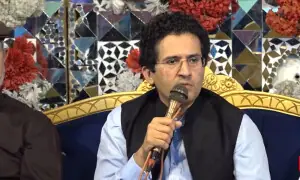
The PFF chairman Mohammad Ali Shah expressed the sentiments of all countries at the world moot. He said, "Ours is an ongoing struggle for existence and livelihood and we are being deprived by the process of globalisation the ruthless commercialism." This is the plight of fisherfolk the world over and not peculiar to Pakistan or even Asia. Fisherfolk in America, Africa and Europe face similar problems, and similar neglect of their plight by their governments.
With less fish in the rivers and seas due to extensive, indiscriminate commercial fishing, fisherfolk families are in search of alternate occupations. The greatest harm is to traditional methods of fishing which were ecofriendly. While the waters were fished for food, fisherfolk did not harm the ecology as the mechanical methods of fishing are doing.
If more and more fisherfolk turn away from their family occupation, a chapter in human history will come to the end. The evolution of human society owes its origin to fishing and not hunting, which anthropologist state was a later development. The first communities of Man were established near water bodies. Man was fisher-sailor long before he became hunter-gatherer. One would certainly not like to see the end of traditional fishing.
But since it is the fisherfolk who are demanding government should give them alternate means of livelihood, it is important to consider what can be done. The PFF should be told, (in fact it ought to know,) that the appeal to the government is useless. It will have to be a self-help project.
One word of warming, though giving up fishing will also mean loss of identity. I will never forget the words of an old woman in a 300-year-old fisherfolk settlement in Keamari who said, "If our menfolk do not go to sea they go mad." She was not talking about mental sickness, she meant they would take to evil ways, to crime. This we have seen to be the case of jobless people of Lyari. The only way to fight crime in Karachi's poorest of the poor communities is to support them in traditional fishing and help them acquire facilities to improve their standard of life.





















Comments
Comments are closed for this article.