


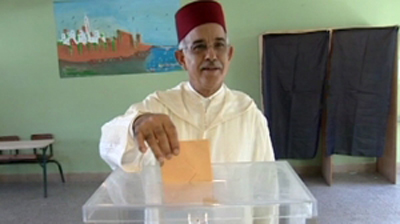
 RABAT: Moroccans go to the polls Friday in the first legislative elections since the approval of a reform of the constitution in July which strengthens the role of parliament and the prime minister.
Opinion polls are not allowed but observers said the opposition Justice and Development Party would make strong gains after a similar success by a moderate party in Tunisia's first democratic election a month ago.
Its main rival is the Coalition for Democracy, an eight-party pro-monarchy bloc that includes two of the current five governing parties -- the Popular Movement and Finance Minister Salaheddine Mezouar's National Rally of Independents party.
In all, 31 parties are vying for the 395 seats in the lower house of parliament -- 70 more than during the last election in 2007.
A proportion of them have been reserved for women and others for younger deputies in a bid to give the assembly, until now dominated by ranking public figures, a more modern look.
Voting stations open at 8:00 am (0800 GMT) and close at 7:00 pm, with provisional official results expected several hours later. Final results will be announced Saturday.
The election comes less than five months after a new constitution which had been proposed by King Mohamed VI as regimes in neighbouring countries were being swept away by the Arab Spring uprisings. It was approved in a July 1 referendum.
The amended constitution gives parliament a greater role in the legislative process and strengthens the role of prime minister, who now must be appointed by the king from the party which wins the most seats in the assembly.
Morocco's complex proportional representation system lends itself to fractured parliaments and no party is expected to obtain an absolute majority on its own. The winning party will have to govern in a coalition.
The Justice and Development Party believes it can build on its current 47 seats in parliament, second only to Prime Minister Abaas El Fassi's Independence Party, and emerge as the most voted party.
It focused at first on social issues, such as opposition to summer music festivals and the sale of alcohol, but has shifted to issues with broader voter appeal like the fight against corruption and high unemployment.
The party promises to cut poverty in half and raise the minimum wage by 50 percent.
Of the 13.6 million Moroccans elegible for voting 57 percent are 35 or younger.
The election campaign has failed to raise much enthusiasm and analysts will be watching closely to see if turnout surpasses the 37 percent recorded during the last election in 2007.
"For the powers that be a strong turnout in the 2011 elections would give credibility to the constitutional reform adopted in July," said Omar Bendourou, a constitutional law professor at Rabat's Mohamed V University.
"And it would give them some credibility, a favourable image abroad of how the kingdom responded to protests."
The king announced he would overhaul the constitution on March 9, just 17 days after thousands of people took to the streets across Morocco calling on him to give up some of his powers in the biggest anti-establishment protests in the country in decades.
While the constitutional reform devolved some of the king's powers to parliament and the prime minister, he remains the head of state and the military and still appoints ambassadors and diplomats.



















Comments
Comments are closed for this article.