


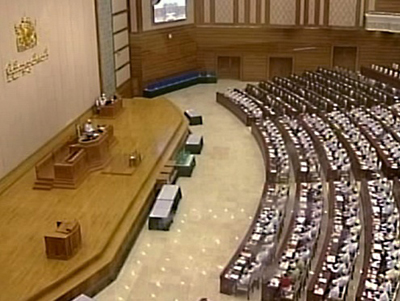
 YANGON: Myanmar's military-dominated parliament has passed a bill allowing citizens to protest peacefully, a lawmaker said Thursday -- the latest in a rapid series of reformist moves in the isolated country.
The bill, which needs to be signed off by President Thein Sein to become law, requires that demonstrators "inform the authorities five days in advance," said upper house member Aye Maung, of the Rakhine Nationalities Development Party.
Protesters would be allowed to hold flags and party symbols but must avoid government buildings, schools, hospitals and embassies, he told AFP.
The bill came before parliament this week, four years after a mass monk-led protest known as the "Saffron Revolution" was brutally quashed, with the deaths of at least 31 people and the arrest of hundreds of monks, many still locked up.
Myanmar's new parliament, dominated by army proxies, opened in January after nearly five decades of outright army rule following an election in November -- the first in 20 years -- that was dismissed by many observers as a sham.
But the new leaders of the country, which is subject to Western sanctions, have since surprised observers with a number of reformist steps in an apparent attempt to end its international isolation.
They have released and held direct talks with long-detained democracy leader Aung San Suu Kyi, halted work on an unpopular megadam, eased media censorship and passed a law giving workers the right to strike.
As a diplomatic prize for its promising gestures, Myanmar last week won approval to chair Southeast Asia's regional bloc in 2014.
It also received a nod from US President Barack Obama, who said he would send Hillary Clinton to Myanmar next month to encourage reform -- the first US secretary of state to visit in 50 years.
Suu Kyi's opposition party announced its return to the official political arena after it boycotted last year's polls.
The freeing of all of the country's political prisoners, whose exact numbers remain unclear, remains one of the major demands of Western nations.
A small group of monks risked a rare two-day protest in Myanmar earlier this month, calling for their release as well as freedom of speech for monks and an end to conflicts between the army and ethnic minority groups.



















Comments
Comments are closed for this article.