


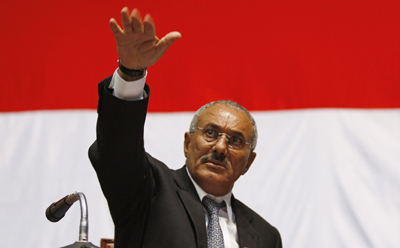
 RIYADH: Yemeni President Ali Abdullah Saleh signed a deal on Wednesday to hand over his powers after 33 years in office, ending months of delay that had seen protests that erupted in January slide into deadly unrest.
King Abdullah of Saudi Arabia, who hosted the signing ceremony at his Al-Yamama palace in Riyadh, hailed a "new page" for the impoverished neighbouring country while Washington welcomed "a significant step for the Yemeni people."
Saleh promised "real partnership" with the opposition in implementing the Gulf- and UN-brokered agreement, but thousands of demonstrators again to took to the streets of the capital Sanaa to protest against the deal's promise of immunity from prosecution for both him and his family.
A spokesman said they rejected the agreement and called for further mass demonstrations.
The organising committee of youth protesters said the Gulf-brokered deal "does not concern" them, Walid al-Amari told AFP.
Under the agreement, which Saleh had stalled for months in defiance of intense domestic and international pressure, the veteran leader will hand his powers to Vice President Abdrabuh Mansur Hadi but remain honorary president for 90 days.
Saleh has repeatedly backed out of signing the deal brokered by Yemen's wealthy Gulf neighbours since the parliamentary opposition inked it back in April.
During his months of prevarication, deadly clashes between loyalist and dissident troops had riven the capital, while militants, some linked to Al-Qaeda, took advantage of the decline of central government control in the provinces to set up base.
But at Wednesday's signing ceremony, Saleh insisted: "We welcome partnership with the opposition to manage the country's affairs and rebuild what the crisis has destroyed."
UN chief Ban Ki-moon said he had called Saleh on Tuesday and "strongly urged" him to sign the deal, which his Yemen envoy Jamal Benomar played a major role in brokering during repeated visits to Sanaa.
"I told him that the United Nations will spare no efforts... so that... peace and stability and democratic order will be restored in Yemen," Ban said.
"I understand the arrangement and agreement is that he will still remain as president. But he told me that he will come to a deal to take medical treatment immediately after signing this agreement," he said.
The 69-year-old Saleh sustained serious blast wounds in a June bombing of his residence for which he has already received extensive treatment in Saudi Arabia.
Under the roadmap brokered by Benomar, Saleh will hand to Hadi "all powers necessary for proceeding with the Gulf initiative and its implementation mechanism and for organising early elections within a 90-day period which begins immediately after the signing."
Saleh will remain honorary president for 90 days until Hadi is elected as consensus president for an interim two-year period.
The parliamentary opposition, which co-signed the agreement in Riyadh, will put forward a candidate to head a government of national unity, which will be charged with holding talks with the youth activists who have spearheaded the 10 months of protests, the UN envoy said.
"The United States applauds the Yemeni government and the opposition for agreeing to a peaceful and orderly transition of power," State Department spokesman Mark Toner said.
"We urge all parties within Yemen to refrain from violence and to move swiftly to implement the terms of the agreement in good faith and in transparency," Toner added.
But an opposition spokesman warned that the protesters were unlikely to give up their almost daily demonstrations until Saleh has finally quit office completely.
"People will not go back to their homes until the honorary term ends," Mohammed Qahtan, spokesman for the Common Forum opposition bloc, told AFP.
Protesters again demonstrated in Sanaa earlier on Wednesday against the immunity promised to Saleh and his family from prosecution for their roles in the regime's bloody crackdown that has left hundreds dead and thousands wounded.
"No immunity, no guarantee, Saleh must be tried with his regime," they chanted.
There were also brief clashes in Sanaa between forces loyal to Saleh and dissident troops, residents said.
The unrest has left Yemen's armed forces and security services deeply divided, and under the first three months of the agreement, Hadi will form a committee that will oversee their restructuring.
Saleh's son Ahmed commands the Republican Guards, his nephew Yehya heads the central security services, and Tariq, another nephew, controls the presidential guard.
But two major army divisions -- one in Sanaa and one in Yemen's second-largest city Taez -- rallied to the opposition and have fought repeated battles against Saleh's loyalists, leaving scores dead.



















Comments
Comments are closed for this article.