


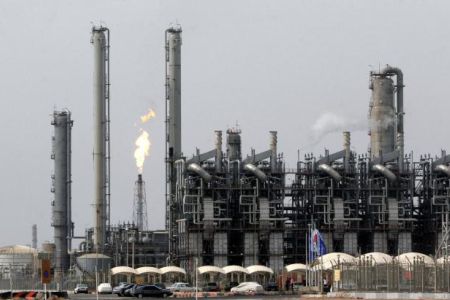
 WASHINGTON: The United States plans to sanction Iran's petrochemical industry, sources familiar with the matter said on Friday, seeking to raise pressure on Tehran after fresh allegations it may be pursuing nuclear weapons.
The sources said Washington wanted to send a strong signal after the UN nuclear watchdog issued a Nov. 8 report saying Iran appeared to have worked on designing an atomic bomb and may still be secretly carrying out related research.
The sources, who spoke on condition that they not be named, said the sanctions could be unveiled as early as Monday.
They said the United States was looking to find a way to bar foreign companies from aiding Iran's petrochemical industry with the threat of depriving them access to the US market.
While European nations have historically resented such "extra-territorial" US sanctions seeking to punish their companies, in this case the sources said the European nations were themselves likely to follow suit, though not immediately.
US firms are barred from most trade with Iran. The US push is therefore aimed at foreign firms by in effect making them choose between working with Iran's petrochemical industry or doing business in the vast US market.
It was not clear what authorities the Obama administration planned to invoke to impose the sanctions or precisely how, and how much, they would hurt Iran's petrochemical sector.
Discussion of the idea comes amid a renewed flurry of Israeli media speculation about the possibility of an Israeli military strike to try to destroy Iran's nuclear facilities.
The United States suspects Iran may be using its civil nuclear program as a cover to develop nuclear weapons. Iran has insisted its program is purely peaceful.
Anxieties about Iran's nuclear program increased after the International Atomic Energy Agency (IAEA) released intelligence last week suggesting Iran has undertaken research and experiments geared to developing a nuclear weapons capability.
ACTION ON FINANCIAL SECTOR?
Iran, which denies it wants nuclear weapons, condemned the findings of the Vienna-based IAEA as "unbalanced" and "politically motivated."
The report increased tensions in the Middle East and led to redoubled calls in Western capitals for stiffer sanctions against Tehran.
The sources familiar with the matter said there had also been discussion of sanctions on the Iranian financial sector.
While US officials last week said the idea of cutting off the Iranian central bank entirely was off the table for now, one source said there had been consideration of more limited measures.
"There was displeasure at the top with the view that it's all or nothing ... (and that if it's all) we take out our own economic recovery," he said. "The instruction was given to look for other possible avenues."
The sources said the United States was reluctant to try to cut off the Iranian central bank entirely for fear this could drive oil prices dramatically higher, potentially impairing the US recovery.
The United States and its European allies, notably Britain, France and Germany, are seeking ways to raise the pressure on Iran without going to the UN Security Council, where fresh sanctions are all but sure to be opposed by Russia and China.
The UN Security Council has passed four resolutions imposing sanctions on Iran but both Russia and China have made clear their reluctance to go further for now.
There has been growing pressure from the US Congress and prominent Republicans, including presidential candidate and Texas Governor Rick Perry and former US Secretary of State Condoleezza Rice, to sanction the Iranian central bank.
Perry advocated the idea in a televised debate on Saturday while Rice did so in an interview with Reuters on Wednesday.
"There is time for diplomacy but it better be pretty coercive diplomacy at this point," Rice told Reuters.
"There are many things we could do even without probably the Security Council: sanction the Iranian central bank, deny them access to the financial system through that," she said.


















Comments
Comments are closed for this article.