


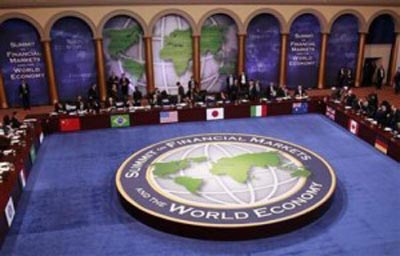
 PARIS: The leaders of the world's economic powerhouses meet on Thursday and Friday this week in the French seaside resort of Cannes hoping to agree measures to head off the threat of global recession.
Between them, the G20 leaders represent economies that generate around 85 percent of global output, and their summit will be dominated by the search for growth and the European plan to contain the eurozone debt crisis.
But, in this the last week of France's G20 presidency, the group will also be called upon to study a number of specific economic issues. Here is a breakdown of some of the other questions on the table:
BANK BONUSES:
The G20's current chairman, summit host President Nicolas Sarkozy of France, has branded the traders' bonus culture in the world's banks a "perverse incentive" to take dangerous risks on the market.
Two years ago at the G20 summit in Pittsburgh, world leaders issued a deal to better limit and regulate pay-out, and the subject will be on the agenda once again in Cannes.
With many EU banks in need of state aid to recapitalise, some European countries are pushing forward with regulation, but there remains reticence in the United States to further tighten the rules.
TAX HAVENS
The leaders will be presented with reports from a global forum on banking secrecy and tax avoidance run by the OECD, detailing which countries still allow foreign nationals to hide revenue in offshore banks.
Switzerland is still under pressure to do more to open up its banks to scrutiny, and the reports finger Brunei, Uruguay and Vanuatu for criticism. France will press for tougher global measures against backsliders.
FINANCIAL TRANSACTION TAX
France and Germany have been pushing for a small tax on financial transactions as a mechanism to force markets to help pay for government efforts to rescue an economy laid low in part by their excesses.
The idea ran into opposition from the United States, Canada, Russia and China and Paris and Berlin are now resigned to going it alone, either in the 17-nation eurozone or simply bilaterally.
They will brief their comrades on this plan, and perhaps push for different global measures raise funds to fight poverty and climate change, such as a tax on shipping.
INTERNATIONAL FINANCIAL REFORM
Another area in which France's grand G20 ambitions have been derailed by political and economic reality is the plan to use regulation to stablise and "re-found" global financial capitalism.
But meeting earlier this month in Paris, G20 finance ministers said they had made "fundamental" breakthrough in the quest for new ways to manage and in some cases limit global capital flows.
THE YUAN
Underlying much of the instability in global markets is the massive trade imbalance between China and its US and EU partners, blamed in the West on Beijing's reluctance to let its currency the yuan appreciate.
With Europe going cap in hand to seek investment in its debt repayment vehicles, there is likely to be less overt pressure on China, but France hopes for progress on the yuan's incorporation in the IMF's Special Drawing Rights.
The SDR is a sort of global reserve asset based on a basket of major currencies, and the yuan's inclusion would lead to it eventually becoming de facto convertible.





















Comments
Comments are closed for this article.