


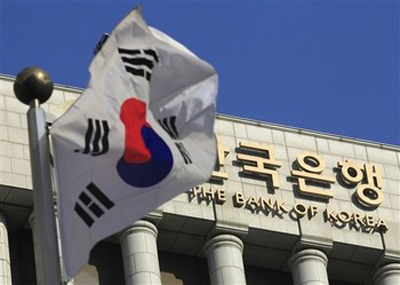
 SEOUL: Heavy money inflow since the 2008 financial crisis and a high stock market turnover ratio make South Korea especially vulnerable to massive capital flight in times of global stress, the country's central bank warned in a report on Sunday.
Net foreign purchases of South Korean securities reached more than 8 percent of the annual gross domestic product between the second quarter of 2009 and the end of 2010, above some 4 percent on average for emerging economies, it said.
The turnover ratio on the Seoul stock exchange stood at 178.5 percent as of October last year, the highest after China among 25 emerging economies, the Bank of Korea noted in its biannual financial stability report.
Moreover, US and European investors held a massive 75.5 percent of the total foreign ownership in South Korean stocks and 53.1 percent of that in bonds, it said.
These and the country's heavy reliance on short-term overseas borrowing make South Korea especially vulnerable to massive capital flight if the euro zone's debt crisis and US economic slowdown cause problems, it said.
The report was published after South Korea sharply expanded currency swaps with neighbours China and Japan this month, adding nearly $100 billion in dollars, yuan and yen to the pool it can tap into quickly in case of emergency.
Domestically, the central bank called for a careful watch on liquidity at credit card issuers, citing an unusually heavy debt rollover burden between the second half of this year until the end of next year.
As of the end of June, 18 trillion won ($16.29 billion) worth of bonds issued by credit card companies -- or 52 percent of the total outstanding -- were due to mature before the end of 2012, it said.
If credit card companies face trouble in rolling over or repaying the maturing bonds, that could threaten not only the individual card companies but other financial institutions they owe, the central bank said.






















Comments
Comments are closed for this article.