

China warns on trade protectionism

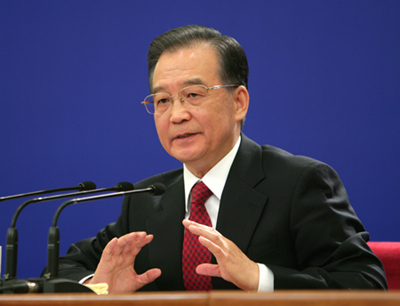 BEIJING: China's Premier Wen Jiabao said Friday rising protectionism is damaging the global economy, days after the US Senate passed a bill aimed at punishing Beijing for alleged currency manipulation.
Wen made no specific mention of the United States, but his remarks followed a storm of protest in China over the bill, which Beijing has warned could start a trade war between the world's top two economies.
"What is worrying is that... trade protectionism is rising sharply," Wen told exporters in a speech carried on state television. "Trade protectionism will only slow the pace of world economic recovery."
Wen said countries should be "rational" in dealing with trade disputes as the world grappled with a mounting debt crisis.
"The shadow of an international financial crisis could be removed as soon as possible... only if we properly handle international trade friction in a more rational way," he said.
Wen was speaking at the opening of China's largest trade fair, held twice a year in the southern city of Guangzhou.
Later in the day, Vice Premier Li Keqiang was more direct in singling out the US in a meeting with visiting former secretary of state Condoleezza Rice.
"China hopes US relevant parties and all sectors of the society can reject protectionism and create a favorable environment for the healthy development of bilateral economic and trade relations," Li told Rice, according to the official Xinhua news agency.
Rice, a guest of the Chinese People's Association for Friendship with Foreign Countries, said she was willing to advance bilateral relations and economic and trade cooperation, Xinhua said.
Some US lawmakers and officials say China's currency is undervalued, giving the country an unfair trade advantage by making its exports cheaper.
Wen's comments came after the United States said its trade deficit with China rose to a record level of $29 billion in August, data that is likely to fuel allegations China keeps its currency artificially weak.
Many in Washington say that China keeps the yuan unfairly low against the dollar, giving its goods an edge of as much as 30 percent over similar US products, widening the trade deficit and costing American jobs.
Leaders in the US House of Representatives have signalled they would block the currency bill -- meaning it will not become law -- but anti-China sentiment is on the rise ahead of US elections in November 2012.
Beijing has denounced the bill as a "ticking time-bomb" that threatens to blow up trade ties between the economic superpowers.
China's overall trade surplus actually narrowed to $14.51 billion in September as exports slowed, hit by economic turmoil in the United States and Europe, according to official figures.
The country's exports rose 17.1 percent year-on-year to $169.7 billion, slowing from a 24.5 percent rise in August.
Worries over slowing overseas sales will prevent China from allowing its currency to appreciate more sharply, amid fears this would hurt exports, which are a major driver of economic growth, analysts said.
China defends its exchange rate regime, saying it is moving gradually to make the yuan currency more flexible.
The yuan has risen more than seven percent against the dollar since mid-2010, when Beijing relaxed a de facto peg to the US currency, imposed in 2008 to protect its exporters during the global financial crisis.
China also said Friday that it had asked the World Trade Organization to intervene in two separate trade disputes with the United States over shrimp and saw blades, which Washington accuses Chinese producers of dumping.
Beijing has asked the world trade body to set up a panel of experts to help address anti-dumping measures taken by the United States in the two cases, China's Ministry of Commerce said in a statement.




















Comments
Comments are closed for this article.