


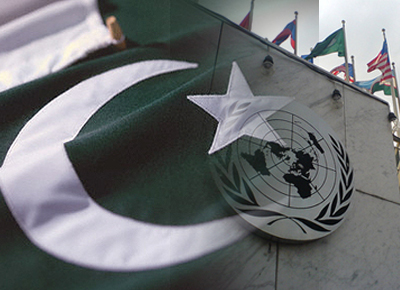
 UNITED NATIONS: Pakistan told the international community Tuesday that its firm opposition to the start of talks on a treaty to ban production of fissile material used as fuel for nuclear weapons was not "out of choice, but compulsion," as the move would have adverse consequences to "our region."
"No country can be expected to compromise on its fundamental security interests," Raza Bashir Tarar, Pakistan's deputy permanent representative to the UN, said in a speech to the General Assembly's Disarmament and International Security Committee.
Over the last few years, he said that the discriminatory policies of some major Powers -- an obvious reference to the US-India nuclear deals -- had accentuated the asymmetry in fissile material stocks in South Asian region.
"These powers have pursued these policies in utter disregard for international non-proliferation goals and indeed their own non -proliferation commitments," the Pakistani delegate added.
For the past couple of years, Pakistan has been blocking the launching of negotiations on the proposed treaty at the Conference on Disarmament in Geneva on the ground that it prejudicial to its national security interests.
Experts point out India has a larger stock of fissile material than Pakistan does, and a greater capacity to build warheads. Tarar said despite loud voices of concern and grandstanding in the international media, and fully cognizant of the impact of those policies on the regional security situation, those Powers had continued their policies of exceptionalism for their pursuit of power and profit.
They had no moral authority in calling for strengthening the nuclear non-proliferation and disarmament regime when they themselves were responsible for undermining it.
The Pakistan delegate especially asked members of the nuclear suppliers group if, when they endorsed those discriminatory policies, they were not aware of the adverse consequences to the South Asian region and to the disarmament and non-proliferation regime.
Unfortunately, he said, in the absence of good faith, confidence and mutual trust, Pakistan was compelled to take a stand against nuclear selectivity and discrimination.
Pakistan, along with the 120 members of the Non-Aligned Movement, supported commencement of negotiations on nuclear disarmament.
The Conference on Disarmament had been singled out for its inactivity, alongside the reality that nuclear disarmament, the raison d'etre of the Conference, remained unfulfilled after 32 years, the Pakistan delegate said.
The reasons behind the deadlock were multifarious, rooted in the continued lack of political will of States and not related to procedural rules.
That situation reflected prevailing political realities as the Conference did not operate in a vacuum.
Any solution should be comprehensive and applicable to all of the disarmament machinery's aspects, and not just to issues that were a priority to some delegations.
Moreover, Tarar said, during the Conference's stalemate, the major Powers had not allowed any consideration of the Fissile Material Cut-off Treaty (FMCT). Now, with sufficient stocks available, that material had become cost-free for some of the major Powers, hence, the 'mantra' about such a treaty being the next logical step and an issue ripe for negotiation, he said.
Their logic followed the dictates of convenience and not the needs of global peace and security. If the time is any measure of judgment for ripeness or importance, we must be aware that the issue of nuclear disarmament and negative security assurances are facing a stalemate for over two decades, he said.
The Conference was not created to negotiate a fissile material treaty, and if there was no consensus on one issue due to security concerns of States, other issues should be taken up. Unfortunately, he said, in the absence of good faith, confidence and mutual trust, his country was compelled to take a stand against nuclear selectivity and discrimination.
Pakistan, along with the 120 members of the Non-Aligned Movement, supported commencement of negotiations on nuclear disarmament.




















Comments
Comments are closed for this article.