


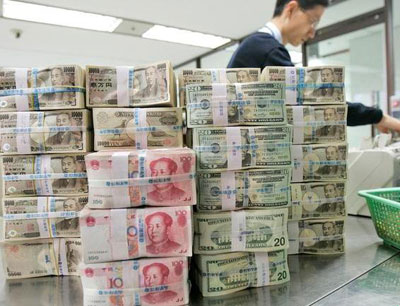
 SEOUL: South Korea's economy grew slightly faster than previously estimated in the second quarter thanks to greater spending on public construction projects, the central bank said Tuesday.
Asia's fourth largest economy grew 0.9 percent quarter-on-quarter in April-June compared to the 0.8 percent estimated in July.
However, the second-quarter growth in gross domestic product was still much slower than the 1.3 percent rise seen in January-March.
Year-on-year the economy grew 3.4 percent in the second quarter, the same as earlier forecast.
Central bank policymakers hold their monthly interest rate-setting meeting Thursday, amid rising domestic inflation but gloomier world prospects which weigh on the country's export-dominated economy.
The finance ministry warned of "substantial" economic uncertainties and pledged to closely monitor domestic and external conditions and improve the country's ability to absorb external shocks.
"Downside risks to the global economy and volatility in local and external markets have increased, while domestic price pressures are high," it said in a monthly summary.
"Uncertainties to economic conditions are substantial."
The ministry said the government would intensify efforts to curb inflation, which hit a three-year high in August of 5.3 percent.
It said the government would bolster the country's ability to absorb external shocks by improving its fiscal standing, ensuring a soft landing for household debt and restructuring ailing savings banks.
Manufacturing output grew 1.4 percent quarter-on-quarter compared to a 3.1 percent gain in January to March. Construction output rose 2.6 percent, after a 6.1 percent fall in the first quarter.
Moody's Analytics saw the upward revision in investment as positive and said infrastructure investment should help productivity and growth in later years.
But it noted that manufacturing output decelerated markedly, as Japan's March 11 earthquake hit the regional electronics supply chain.
"Moreover, the outlook for exports is not good given the weak US and European economies, so an export rebound is looking less likely," it said in a commentary.
But Moody's Analytics said the central bank was still expected to hold its base rate at 3.25 percent in the near term to assess the impact from global turmoil.
While a weaker global economy would hit exports, falling commodity prices would cut inflation and the import bill, "and this is giving the central bank flexibility to halt tightening for now".
Copyright AFP (Agence France-Presse), 2011


















Comments
Comments are closed for this article.