


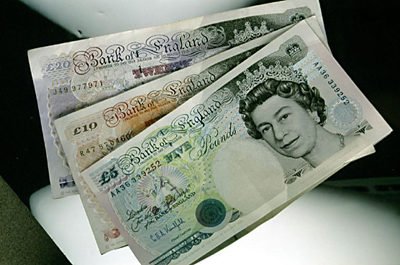
 LONDON: Sterling rose half a percent to a four-week high against the euro on Wednesday after the European Central Bank said it had no plans to curb or curtail its 1.1 trillion-euro asset-purchase programme.
Describing speculation that the fledgling 60 billion-euro-a- month scheme would be scaled back as "surprising", ECB President Mario Draghi made clear quantitative easing would last until September 2016 or until inflation was back up to target.
The euro fell across the board after Draghi's press conference, reaching 71.67 pence against sterling, its weakest since March 19. It later recovered to 71.71 pence, still down 0.5 percent on the day. Despite data earlier this week showing inflation at zero for a second month, Britain's economy is growing overall.
Investors expect the Bank of England to start raising interest rates next year, in contrast to the ultra-loose policy in the euro zone that the ECB has said will last until at least September 2016.
"Some people were thinking that (Draghi) would start talking about tapering, but he reaffirmed the ECB's position that they would be looking to stick to their plans of doing QE until September 2016," said Angus Campbell, senior analyst at online broker FxPro.
"For sure the BoE will move before the ECB, and I think investors are just factoring that back in."
Against a dollar depressed by weaker-than-expected industrial data, the pound recovered from earlier losses to trade at $1.4785, flat on the day.
It had fallen as low at $1.4701, amid uncertainty about parliamentary elections on May 7. There has been much hedging against potential volatility around the election, which is expected to yield no outright winner.
But the pound's trade-weighted value has been stable for almost two months and is up more than 1 percent this year.
However, Adam Myers, European head of FX strategy at Credit Agricole, said he interpreted opinion polls as turning against Prime Minister David Cameron's Conservatives, usually favoured by London's right-leaning City.
"Just because the pound hasn't really suffered very much ahead of the election doesn't mean that it won't," Myers said.
"As of today, we still favour sterling as a safe haven against the possibility of Greece leaving the euro zone, but if the polls go against Cameron for a couple more days, we will see sterling undermined."

























Comments
Comments are closed for this article.