


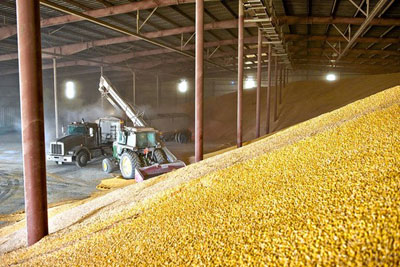
 CHICAGO: With premiums built into US grain markets now well drained, traders this week will be scouring for evidence that consumers see value at these lower prices or if there are grounds for more blood-letting.
The approximate 20-percent drop in the price of corn from an all-time high near $8 per bushel three weeks ago has already drawn China, the world's second-largest consumer of the grain, back into the market, and others are expected to follow.
There is also a sense of relief in the ethanol sector while the livestock industry could consider herd expansion as feedstock stocks for both businesses become more manageable.
But it remains to be seen if any pick-up in demand will help offset the weight placed on prices by the US Department of Agriculture -- which raised its estimate of corn acreage in the United States to 92.3 million acres on Thursday 1.5 million acres more than trade expectations.
Also, the department's estimate of corn stocks as of June 1 exceeded trade estimates by nearly 370 million bushels.
"The question now is if corn is at value," grains analyst Don Roose of US Commodities in West Des Moines, Iowa, said.
"It looks like beans have found value," he said, as Chicago Board of Trade soybean futures rallied on Friday even as corn futures slumped for a second day.
The USDA's acreage and quarterly grain stocks data on Thursday triggered a record fall in CBOT corn futures, with the July contract, trading without the encumbrance of daily limits, falling as much as 83 cents, or about 12 percent.
With the likelihood of a record-large US corn crop this year and stocks suddenly not as tight as previously feared, demand will be key in keeping prices from drifting lower.
Analysts generally agree that corn prices have peaked this year after a blistering rally that began nearly a year ago more than doubled prices before the sell-off began last month.
Roose sees prices for December corn futures the first contract to reflect prices for supplies harvested this year to range in the $5.50 to $5.75 per bushel area, saying the USDA reports have created a "new fundamental landscape."
Investment bank and commodities bull Goldman Sachs on Friday slashed its three-month corn price forecast 26 percent to $5.90 per bushel from $8. Its 12-month forecast was cut 18.5 percent to $7, from $5.70 per bushel.
Agricultural economist Darrel Good of the University of Illinois said corn prices could drop to about $4.50 per bushel in the longer term, adding that the time it takes for prices to get to that level will be determined by a variety of reasons.
"It won't go there directly," he said, adding that weather in July when the corn crop goes through its key development stage of pollination will be a key factor.
Any kind of stress from high heat or insufficient rains during the summer would have an impact on corn yield.
"And it (price) always comes back to value," he said.
Good said traders and farmers have to take USDA's acreage data at face value, adding that he expected the department to only make a slight reduction in its estimate after a resurvey of key states where planting was affected by excessive rains.
The USDA will survey Minnesota, Montana, North Dakota and South Dakota to assess how much land was planted with corn, soybeans and wheat.
Good said the USDA's quarterly grain stocks report in September could be a surprise.
The USDA started a year-long rally in corn prices which ended last month -- when its June 30 quarterly stocks report put corn stocks at 288 million bushels above trade estimates.
In its quarterly stocks report in September, the USDA's corn stocks estimate was nearly 300 million bushels more than the trade had expected.
Good raised the possibility of the USDA revising down its corn stocks estimates in its September report. "There is a good chance that the report will be friendly," he said.
Copyright Reuters, 2011























Comments
Comments are closed for this article.