


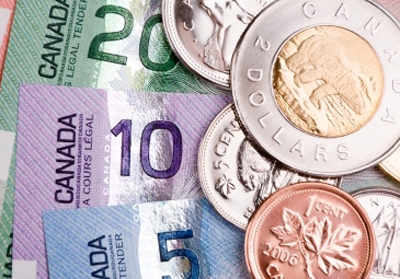
 TORONTO: The Canadian dollar weakened against the greenback on Monday, hurt by concerns that diverging paths for central bank policy could leave the Bank of Canada on the sidelines even when the Federal Reserve ultimately starts raising rates.
On the economic front, the loonie had few catalysts, with no domestic data on the docket until Friday's gross domestic product report. Analysts are forecasting the economy likely bounced back in the second quarter after being hit by unusually severe winter weather in the first three months of the year.
But the market homed in on comments made by Bank of Canada Governor Stephen Poloz in Jackson Hole, Wyoming over the weekend. Poloz said the Bank of Canada won't necessarily immediately follow the United States when the Fed starts hiking rates, the Globe and Mail reported.
"The focus has been on the Poloz comments made over the weekend, where he's very definitely trying to talk down the idea of interest rates moving up in line with the US when the Fed eventually starts to tighten," said Shaun Osborne, chief currency strategist at TD Securities in Toronto.
"He's trying to draw perhaps a little more blue sky between the policy outlook in the US and that of Canada."
Analysts expect the Bank of Canada won't raise rates until the third quarter of next year, a Reuters poll conducted last month found. At the same time, there has generally been the view that Canadian monetary policy will follow that of the United States.
The comments "suggest they're not going to be as tightly linked to the policy outlook in the US as some people currently think they will be," said Osborne.
The Canadian dollar was at C$1.0971 to the greenback, or 91.15 US cents, weaker than Friday's close of C$1.0945, or 91.37 US cents.
Speaking at the annual meeting of policymakers and economists in Jackson Hole, Fed Chair Yellen said last week the central bank should move cautiously in deciding when to raise rates, even as a number of top Fed officials pressed their case for an early hike.
Canadian government bond prices were higher across the maturity curve, with the two-year up 1 Canadian cent to yield 1.089 percent and the benchmark 10-year up 19 Canadian cents to yield 2.054 percent.

























Comments
Comments are closed for this article.