


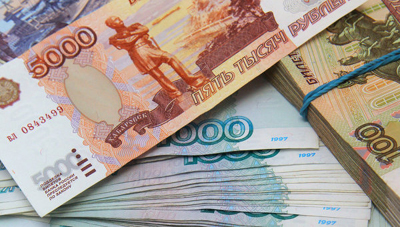
 MOSCOW: The Russian rouble strengthened for a second day on Wednesday to reach a two-week high after investors started closing long positions in the dollar taken during the recent escalation of the crisis in Crimea.
At 1525 GMT, the rouble traded 0.7 percent stronger against the dollar at 35.97 and 0.9 percent firmer at 50.0 against the euro. This left it 0.8 percent firmer against the dollar-euro basket at 42.29.
The rouble, which hit record lows on Monday on concerns over the economic fallout of Russia's standoff with the West over Ukraine, has rallied since Russian President Vladimir Putin indicated in a speech on Tuesday that Moscow had no plans to seize other parts of Ukraine beyond Crimea.
"Why shouldn't the rouble appreciate now? Tensions over Crimea had resulted in huge amounts of foreign currencies being purchased from the central bank and now these positions are being unloaded," said a trader at a large Western bank.
The central bank has spent almost $23 billion on defending the rouble since Putin declared on March 3 that Russia had the right to invade Ukraine to defend Russian-speakers there if needed.
VTB Capital analysts said the rouble has lagged other emerging market currencies by about 9 percent so far this year, depressed by political risk.
"If the dust settles (over Ukraine), the rouble has plenty of room for appreciation, especially given the exporters' offer has been thin so far," the analysts wrote in a note.
Russian exporters need to convert foreign currency revenues each month to pay a series of taxes.
Investors in the stock market, however, were far more cautious due to lingering uncertainty about whether the West will step up its response to Russia's annexation of Crimea. That pushed down Russian shares, halting a two-day rally.
The dollar-denominated RTS index was down 0.5 percent at 1,155.8 points while the rouble-traded MICEX lost 1.3 percent to 1,319.1 points, both giving up their early-session gains.
"Investors took a wait-and-see position because the reaction of the US and the European authorities to Putin's speech yesterday is not clear yet," said Sofia Kirsanova, an analyst at Raiffeisen Capital in Moscow.
"At the same time, domestic and foreign businesses are seriously worried about the (conflict) between governments and actively discuss the possible consequences of economic sanctions against Russia."
Andrew Cole, Investment Director of the Global Multi Asset Group at Baring Asset Management, said in a note that the situation was still in flux and markets tended to be driven much more by politics than fundamentals.
"And while we foresee a number of risk areas related to the situation, we do not expect that the situation heralds the return of a new Cold War," he said.
























Comments
Comments are closed for this article.