


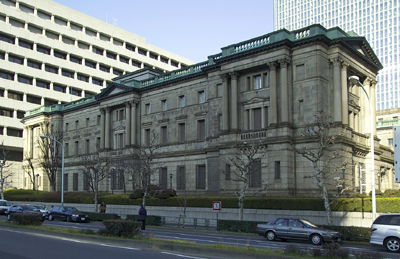
 TOKYO: The Bank of Japan is expected to keep monetary policy steady on Friday despite the news that the devastating earthquake in March pushed the economy into recession as it sees growth picking up later this year when the wounds from disaster begin to heal.
The world's third largest economy shrank much more than expected in the first quarter and stumbled into recession after the triple blow of a magnitude 9.0 earthquake, tsunami and nuclear crisis hit business and consumer spending and tore apart manufacturers' supply networks.
The BOJ sees the current downturn as a temporary rough patch, a view shared by Economics Minister Kaoru Yosano, and focuses more on whether the economy will resume a recovery in the second half of this year as it projects.
That means that the BOJ will wait for more clues on the timing of the recovery, and use its limited policy options only if a sudden market shock or prolonged disruptions to output hurt sentiment and spending.
Still, some analysts see a good chance supply bottlenecks caused by the quake will force the central bank's hand if they persist for several months, hurting output and exports.
"As the economy is expected to stay weak, the Bank of Japan may have to take further monetary easing measures, such as possibly increasing the amount of its purchases of Japanese government bonds," said Takeshi Minami, chief economist at Norinchukin Research Institute.
This week, the BOJ is widely expected to keep interest rates unchanged at a range of zero to 0.1 percent and maintain the 10 trillion yen limit ($122 billion) of its asset buying scheme.
The weak GDP data may prompt Deputy Governor Kiyohiko Nishimura to renew his call for more policy loosening. Nishimura was the only member of the nine-strong board to call for easing last month and he is likely to be voted down again. Markets will focus, however, whether such a proposal will find more supporters.
While no further easing appears imminent, the BOJ is expected to maintain its ultra-loose policy bias for at least another year even as other central banks, such as the Federal Reserve and the European Central Bank, start to roll back huge stimulus activated after the collapse of Lehman Brothers late in 2008.
Given risks to recovery, such as a threat of power shortages during the summer, BOJ Governor Masaaki Shirakawa is expected to stress the bank's readiness to ease policy further if Japan struggles to return to growth.
Any further easing will come through topping up of the BOJ's asset buying programme, although some in the bank would like to focus more on directly supporting rebuilding efforts in the quake-hit northeast.
While no conclusion is expected on Friday, the board may start debating what measures would be feasible and Shirakawa may offer some clues.
The BOJ eased policy days after the quake by doubling the funds set aside for purchases of a range of financial assets including government bonds and corporate debt.
It has held monetary policy on hold since then and has so far purchased nearly 4 trillion yen worth of assets.





















Comments
Comments are closed for this article.