


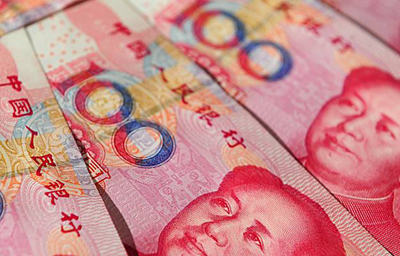
 HONG KONG: China's currency rose to a record high against the US dollar for a second consecutive day on Tuesday after the central bank relaxed its grip on the yuan's movements.
The People's Bank of China (PBOC) appears to have flagged a new round of appreciation for its tightly-managed currency into the closing days of the year after it aggressively fixed the daily midpoint at a record high for a third consecutive day.
In opening trades, the yuan, also known as the renminbi, rose to a record 6.0703 per dollar compared to the previous close of 6.0723 per dollar after the central bank fixed the yuan's daily midpoint at 6.1114, its highest since a 2005 revaluation.
While policymakers kept a tight leash on the Chinese currency's movements in November, heavy capital inflows to take advantage of the higher interest rates on the mainland and a revival in sentiment towards the Chinese economy have prompted the PBOC to relax its grip.
The cumulative change in the yuan's fix over the last three sessions marks the biggest since early July, suggesting the central bank may have shifted its currency management policy.
That shift has been dictated by heavy capital flows disguised as trade to exploit the widening interest rate differentials prevailing in the Hong Kong and the mainland markets where bond yields have slowly ratcheted higher in the onshore markets.
Over the last two months, the spread between one-year debt
in the Hong Kong and onshore markets has nearly doubled to 340 basis points, according to Thomson Reuters data.
The combination of the Chinese yuan being the sole bright spot in the Asian foreign exchange markets this year and the PBOC dampening sharp currency moves have prompted companies to exploit the higher yields in the onshore market.
There are signs that China's trade figures are again being distorted by speculative capital inflows disguised as exports of goods and services, with the State Administration of Foreign Exchange (SAFE) announcing over the weekend it will clamp down on the usage of foreign currency for trade finance.
Moreover, banks' FX purchases year-to-date is at a CNY 2.1 trillion compared to CNY 434 billion in the same period last year, a rough indicator of the amount of capital flows into the mainland while the trade surplus in November jumped to a staggering $33.8 billion.
HSBC strategists say it is hard to see how policymakers can resist a stronger yuan when both the current and the capital accounts are experiencing strong inflows, an unavoidable outcome of the interest rate liberalization process.
The one-year Chinese debt yield is at an attractive 4.06 percent compared with 2.6 percent for the Korean won, the next best performing Asian currency this year.
"As a result, it should not be a surprise to see another move lower in the USD-CNY fixing, as the PBoC seems to be giving in to the stronger inflow pressures and allowing the currency to move in a manner that is more in line with its reform goals," they said in a note.
The currency has risen 2.7 percent so far this year and is heading for a 3 percent appreciation for 2013 assuming it moves closer to 6.05 per dollar by year-end, tripling a 1-percent rise in 2012 and exceeding traders' expectations for a 2-percent gain.


























Comments
Comments are closed for this article.