


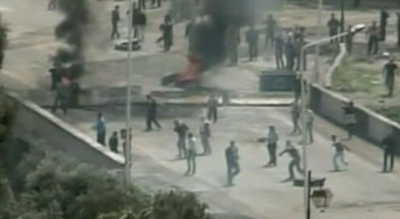
 DAMASCUS: Syria braced for more protests Friday, a day after President Bashar al-Assad made a conciliatory move by signing a decree to lift almost five decades of draconian emergency rule.
Human rights groups said the demonstrations on Friday would prove a test case for Assad and his reforms.
Assad, in power since replacing his father Hafez as president in 2000, issued the order to scrap the state of emergency and decrees to abolish the state security court and allow citizens to hold peaceful demonstrations.
The announcements were flashed in quick succession on state television.
The moves are aimed at placating more than a month of unprecedented protests across the country, ruled by one of the Middle East's most autocratic regimes since the Baath Party seized power 48 years ago.
Two prominent rights activists welcomed Assad's action but called for more changes while a key cyber activist insisted the people now want regime change.
"Lifting the emergency rule and the abolition of the state security court
are positive steps but over the next few days we will monitor closely the security forces to see if they violate the law," said Rami Abdul Rahman of the London-based Syrian Observatory for Human Rights.
"Now we expect the release of thousands of people who have been sentenced" by the state security court, he said.
Human rights lawyer Haitham Maleh renewed calls to scrap an article in the constitution referring to the Baath as sole leader of Syria's state and society, and said Law 49, under which Muslim Brotherhood members can be condemned to death, must also be abolished.
Meanwhile, Beirut-based Syrian cyber activist Malath Omran, a key player behind the protests, said ending emergency rule will "change nothing" in Syria, where the people now wanted a change of regime.
"From the first day people took to the streets with one goal in mind, the fall of the regime," Omran told AFP over the telephone in Nicosia.
German Foreign Minister Guido Westerwelle welcomed Assad's lifting of the state of emergency as "a first step in the right direction" but cautioned that it should be accompanied by rapid political reforms and an end to violence.
US State Department spokesman Mark Toner concurred, stating that Assad must
"do more, or allow others to do more" if he is going to satisfy the reform demands of the Syrian people.
"It is imperative that these demonstrations are policed sensibly, sensitively and in accordance with international law to avoid further bloodshed on Syria's streets," it said.
"These 'Great Friday' protests could be the largest yet. If government security forces resort to the same extremely violent tactics they have used over the past month, the consequences could be exceedingly grave."
Human Rights Watch, for its part, urged the authorities "to permit Syrians to exercise their right to peaceful assembly" on Friday.
"President al-Assad has the opportunity to prove his intentions by allowing tomorrow's protests to proceed without violent repression."
Security forces and plainclothes police have killed about 220 people in a brutal crackdown on the protests, which broke out in mid-March, according to Amnesty International.
Assad's regime has offered a series of concessions to the pro-democracy movement since the first protests in Damascus on March 15, but the demonstrators have been undeterred, pressing for greater freedoms.
Syria's emergency law restricts many civil liberties, including public gatherings and freedom of movement, and allows the "arrest of anyone suspected of posing a threat to security."
The state security court operates outside the ordinary judicial system and prosecutes suspects considered a threat to the government's authority. Its verdicts cannot be appealed.
A report by Human Rights Watch in 2009 described the state security court as a "kangaroo AFP
On Thursday the president appointed a new governor for Homs, a protest hub, after dismissing his predecessor on April 7 following protest-related violence, said the official SANA news agency.



















Comments
Comments are closed for this article.