


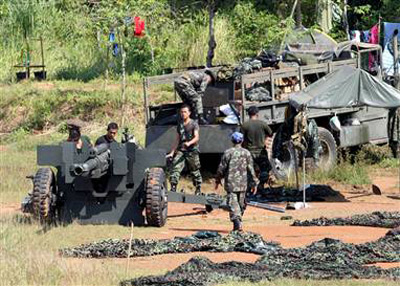
 BANGKOK: Thai and Cambodian troops clashed with gunfire and artillery shells on Friday, leaving one soldier dead and shattering a two-month lull in long-standing tensions at their disputed border.
Both sides blamed each other for starting the fighting, which broke out in the early morning near the Ta Krabei and Ta Muean Tom temples and was still continuing several hours later.
The Thai army said one of its soldiers was killed and five others wounded.
"Cambodian soldiers fired with assault rifles at Thailand first and now they started to shell us with artillery and we took appropriate retaliation," Defence Minister General Prawit Wongsuwon told AFP.
"I think Cambodia wanted to take over temples on the border," he said.
Cambodia accused Thai troops of entering 0.4 kilometers (0.25 miles) into its territory.
"The Thai troops marched directly towards Cambodian troop positions stationed at Cambodia's Ta Krabei temple and launched unprovoked attacks," said government spokesman Phay Siphan.
"This is yet another invasion by Thailand on Cambodia. We cannot accept this."
The Thai-Cambodia border has never been fully demarcated, partly because it is littered with landmines left over from decades of war in Cambodia.
Fierce fighting in February near the 900-year-old Hindu temple of Preah Vihear further east along the border left at least 10 people dead and prompted a UN appeal for a lasting ceasefire.
The two countries accused each other of starting those clashes too.
Ties between the neighbours have been strained since Preah Vihear was granted UN World Heritage status in July 2008.
The World Court ruled in 1962 that the temple belonged to Cambodia, but both countries claim ownership of a 4.6 square kilometre (1.8 square mile) surrounding area.
Observers say the temple dispute has been used as a rallying point to stir
nationalist sentiment in Thailand and Cambodia.
The two countries agreed in late February to allow Indonesian observers in the area near Preah Vihear, but the Thai military has since said they are not welcome.
In February, UN Security Council members, meeting in New York, called for "maximum restraint" by the two countries and a permanent ceasefire.
Cambodia has called for outside mediation to help end the standoff, but Thailand insists the dispute should be resolved through bilateral talks.
Thailand recently admitted using controversial Dual Purpose Improved Conventional Munitions during the February fighting but insisted it did not classify them as cluster munitions.
The arms are defined as cluster munitions by the global campaign group Cluster Munition Coalition (CMC), which condemned Thailand's use of the weapons.



















Comments
Comments are closed for this article.