


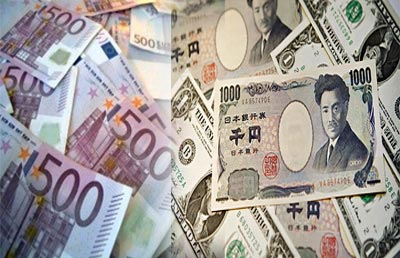
 TOKYO/SINGAPORE: The yen fell broadly, hitting an 11-month low against the euro and nearing a six-month trough versus the dollar, and threatened to re-test long-term support, hurt by expectations for yield differentials to widen and Japan's exports to drop.
The euro showed resilience and touched a 15-month high against the dollar, bouncing back after dipping the previous day in a sell-the-fact type of reaction to a widely-expected rate rise by the European Central Bank.
The euro also hit a fresh 11-month high against the yen. Some traders cited talk of yen-selling by Japanese brokerages and investors, although others said the move was fuelled by overseas players.
Market players said the yen seemed set to see more weakness on the back of interest rate differentials, and concerns about the economic impact from a massive earthquake and tsunami that struck Japan's northeast on March 11.
"It looks like the yen will weaken across the board," said Satoshi Okagawa, head of FX and money trading group for Sumitomo Mitsui Banking Corporation in Singapore.
"It is impossible to imagine at this point just how much Japan's production and exports may fall, but the image is that this is not the type of market condition that calls for buying the yen," Okagawa said.
The euro surged 0.7 percent to 122.47 yen, having touched an 11-month high of 122.630 yen on trading platform EBS.
The euro also climbed to a 15-month high against the dollar, having risen as high as $1.4405 and last at $1.4387, up 0.5 percent from late US trade on Thursday.
Following a widely expected 25 basis-point interest rate hike to 1.25 percent, ECB President Jean-Claude Trichet said the central bank had not decided that Thursday's rate rise was the first in a series of moves.
Economists polled by Reuters expect the ECB to stand pat for a couple of months before raising rates again in July.
The dollar rose 0.3 percent against the yen to 85.140 yen, nearing a six-month high of 85.530 yen hit earlier this week.
Except for its rise against the yen, the dollar was mostly weaker, with the Australian dollar hitting a fresh 29-year high above $1.0500, and the dollar index falling to its lowest since December 2009.
The yen has fallen back after last month's joint G7 yen-selling intervention. Market expectations for interest rate differentials to widen and a drop in market volatility, have stirred talk of a revival in carry trades, a tactic of selling low-yielding currencies such as the yen to fund investment in currencies with higher yields.
Compounding the yen's woes has been market speculation that Japan's trade surplus may narrow or fall into a deficit in coming months.
Japan's demand for overseas goods and resources may increase due to rebuilding efforts. Exports are seen likely to decline after factories and infrastructure were damaged by a massive earthquake and tsunami that struck Japan's northeast on March 11 -- a factor that could temper currency hedging by Japanese exporters and lessen their yen-buying.




















Comments
Comments are closed for this article.