


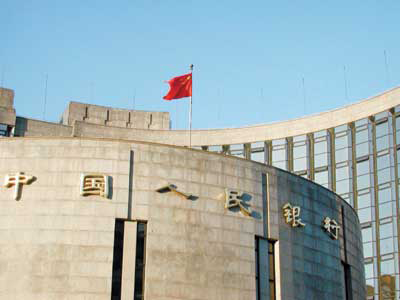
 SHANGHAI: China's central bank has not asked banks about their demand for one-year bills this week, traders said on Monday, meaning it may continue to suspend bill sales to avoid draining cash from the financial system amid a lingering cash crunch.
The People's Bank of China (PBOC) has halted its regular bill auctions since early January, helping to inject money into the financial system as paper it had issued earlier matured, with the principal being returned to banks.
It also conducted reverse bond repurchase agreements to temporarily inject more than 350 billion yuan ($55.2 billion) into the system to stem the usual Lunar New Year cash crunch, as individuals and business withdrew cash for holiday gifts and bonuses.
The PBOC has only 1 billion yuan in bills due to mature this week, so skipping new sales this week means it will mainly be avoiding fresh drains of cash through bills, with money market rates remaining elevated and the reverse repos it conducted earlier in the month set to mature.
Despite the elevated money market rates -- the benchmark weighted average seven-day repo rate stood at around 4.36 percent on Monday morning -- the central bank appears to be taking a cautious approach to cutting banks' reserve requirement ratio (RRR), analysts said.
Many had expected required reserves to be cut ahead of the Lunar New Year holiday, but that never happened. Some analysts suspected that authorities might still be concerned about inflationary pressures, with the consumer price index (CPI) up 4.1 percent in December from a year earlier.
"The central bank may not have a strong intention to cut the RRR so early," said Liu Dongliang, senior analyst at China Merchants Bank in Shenzhen. "I think the mean reason is the CPI number, which could still hover around a high level in the first quarter."
The central bank normally conducts bill auctions on Tuesdays and Thursdays, along with bond repurchase agreements, as a way of keeping money supply growth in check.
That situation has changed as the country has seen smaller inflows of foreign exchange through the trade surplus, with data suggesting it may even have experienced capital outflows in late 2011.




















Comments
Comments are closed for this article.