

Real estate slowdown is upon us. After showing exuberance in the latter half of CY13, the real estate market seemingly lost impetus in 1Q CY14 in the three major urban centers.
According to the data portal of Zameen.com, both the prices and trading activities have slowed down. But, there is nothing wrong with it per se, because the spike in the latter half of CY13 was due to some adverse budgetary measures that had diverted the liquidity to the real estate market.
Plus, there was a general euphoria after the PML-N’s pro-business government took over in June.
Now with the dust settling down, real economic and business happenings are imperative to breathe life in the real estate market, and by extension, in the construction domain.
Urbanisation is rampant in Pakistan. More than one-third of Pakistanis are said to be urban dwellers. By 2025, the Planning Commission had projected in its 2011 Framework for Economic Growth (FEG) that urban residents would grow to half of the total population based on existing enumeration methodology. The proportion would be higher if more accurate population counting and area identification exercise is undertaken.
Therefore, it’s a no-brainer that a great opportunity to enhance GDP growth lies in building and modernising urban centers, promoting high-rise residential and commercial complexes and allowing mixed-use public spaces.
Traditionally, the PML-N governments have remained focused in construction linked to improving the landscape of the cities. But that policy has a transportation bias, with focus only on constructing roads, bridges and flyovers. If it was laying down the motorways in the nineties, the policy tilt led to construction of a Metro Bus service route in Lahore in their last stint.
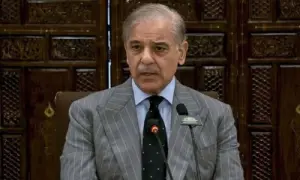
The current Punjab government, under Chief Minister Shahbaz Sharif, is again on a road construction binge. It is in the process of revamping Lahore’s landscape. After the Ferozpour Road’s success and a huge overhead bridge in old Lahore, there are plans to build expressway from Gulberg to Motorway.
It is also in the process of completing Lahore Ring Road that will connect DHA to Motorway, after which it will save the commuters 15 minutes of drive from far flung societies like Bahria Town to DHA and Gulberg.
Perhaps that is why recently real estate activities have been picking up in Bahria Town Lahore, as visible in the Zameen.com quarterly market report.
The PML-N clearly has the will and ability to do big and quality projects in road infrastructure. The natural progression to this is to do the same in housing schemes and high-rise buildings.
Nadeem ul Haq, the erstwhile Planning Commission deputy chairman, also suggested the same in the FEG that was his brainchild and now a legacy.
But, will the Sharif brothers think beyond roads and bridges and move towards mega low-income housing schemes and numerous skyscrapers? Ashiana Housing Project was just one such project. But, it seemed to gain more political mileage than having a real economic impact.
The need is to do much more on a larger scale. Housing is one of the few potential industries that can facilitate the PML-N’s promise of taking GDP growth to 6-7 percent.
There are 37 allied industries that can churn out economic activities in housing construction.
One model is to do what South America did: unlock the potential in land. In Pakistan, large chunks of land are government-owned and are of no economic or social use. The government can allocate pieces of lands to private real estate developers with contractual obligation to build housing units for lower middle class on it.
Back of the envelope calculations suggest that seventy percent of project cost is in building and that can be borne by the private sector participant. Then government can subsidise its land part to give houses to poor people at 70 percent of its actual worth without spending a rupee from its pocket.
Utilisation of one billion dollar worth of land per annum can straight away generate around $2.3-2.5 billion of construction activities. That alone will add 1 percent of GDP to current growth rate of 2-3 percent. Savor that thought!












Comments
Comments are closed for this article.